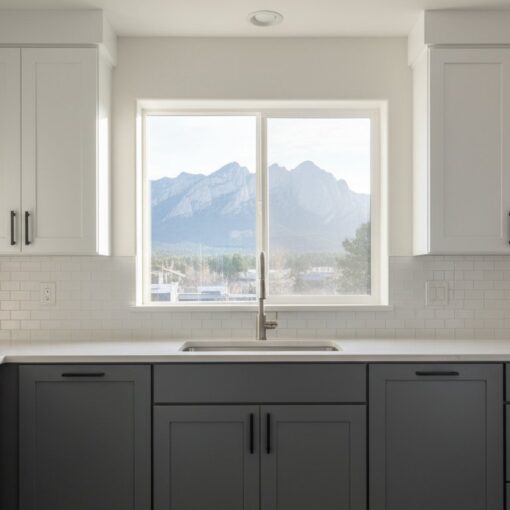
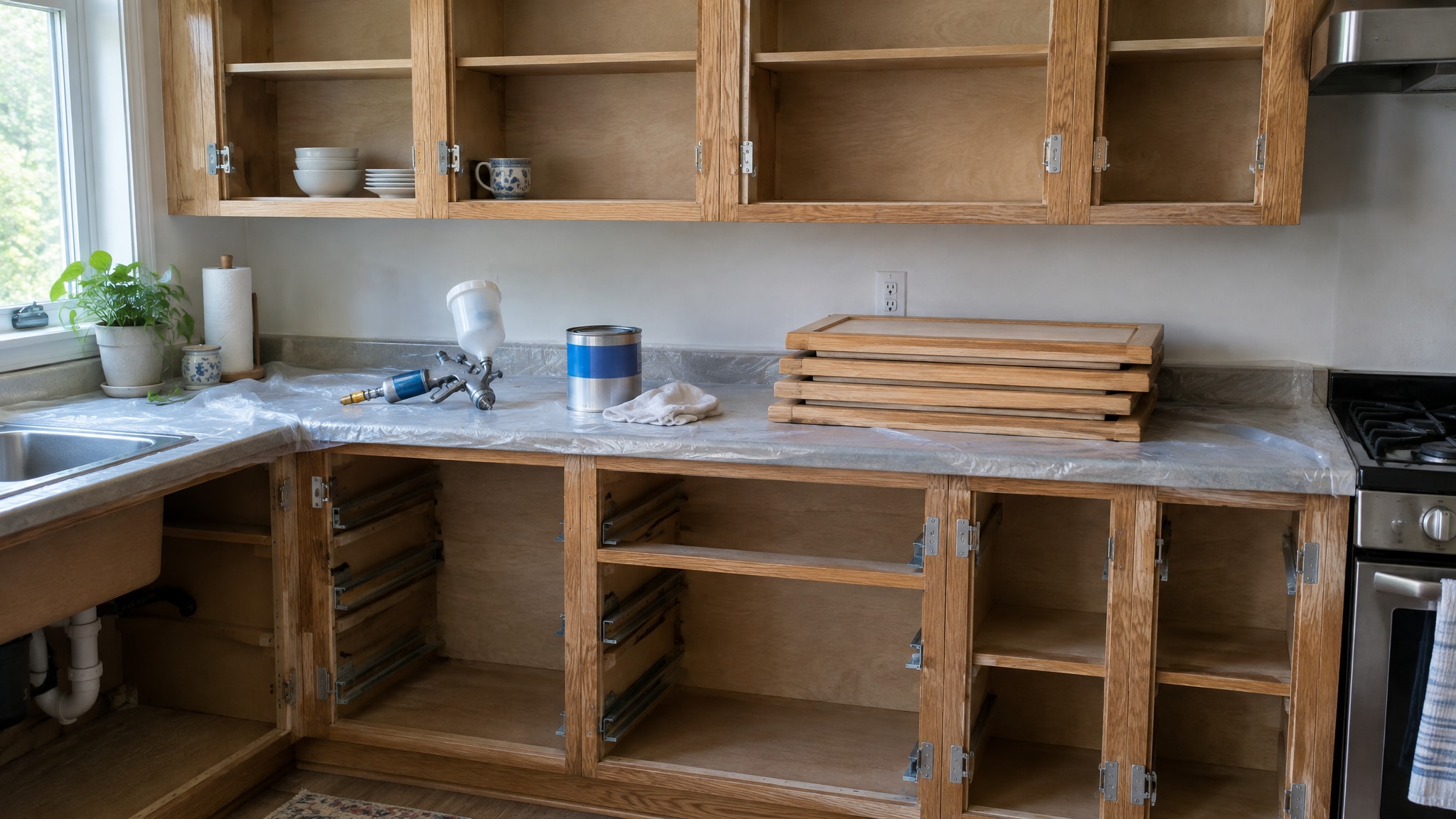
We are not a house painter. We are a cabinet shop, and that difference settles most of what you are about to compare: where the finish goes on, what it is made of, how long your kitchen is torn up, and what is put in writing if something fails. If you are weighing a cabinet refinisher vs house painter for dated but sound oak cabinets, this piece walks one job through both methods. It ends with the questions that expose a thin bid.
Key takeaways
- A cabinet refinisher sprays doors and drawer fronts in a controlled shop booth, while a house painter brushes cabinets in place in your kitchen.
- We remove the doors and drawer fronts and reinstall them in 5-10 days, and any bidder should put a day count in writing.
- Cleaning, sanding and repairs come before any coat, and rushing them is what undermines adhesion.
- Our waterborne precatalyzed or crosslinking urethane lacquer cures tougher than brushed latex, but it is harder-wearing, not chip-proof.
- Compare our 3-year written warranty with any painter’s paperwork term by term before you sign.
One Oak Kitchen, Two Bids: How a Cabinet Refinisher Differs From a House Painter
Picture a dated but sound oak kitchen in Louisville. The boxes are straight, the doors and drawer fronts are solid wood, and the only real complaint is a honey-oak look that stopped being fashionable decades ago. The homeowner collects two bids: one from a general painter, one from us.
General painter vs our shop
| General painter | Our shop | |
|---|---|---|
| Where | In your kitchen | Controlled shop booth |
| Applied | Brushes and rollers | Sprayed |
| Finish | Brushed latex paint | Urethane lacquer |
| Day count | Get it in writing | 5-10 days |
| Warranty | Read their paperwork | 3-year written warranty |
Both bids can be honest. They are still two different jobs.
Who should paint your cabinets comes down to method, and a careful painter’s skill is not the limit. The best brush hand in the county still has to work in your kitchen, and the kitchen sets the ceiling on the result.
The painter’s job. The painter works on the cabinets where they hang. That means masking your counters, floors and appliances, then brushing and rolling in open kitchen air while you cook around it. Dust, pet hair and humidity are all part of the room, and every one of them can land in a wet coat. Doors hung on their hinges are also hard to coat evenly on the edges and backs.
Our job. We remove the doors and drawer fronts, label them, and take them to our shop. There we spray them in a controlled booth, where air and dust are managed instead of left to chance. Then we reinstall them in 5-10 days. Your cabinet boxes stay in your kitchen, and the part that takes a finish never has to dry in a room where you live. If you want to see how the booth and prep flow fit together, the factory finish process lays it out, and we explain why shop-sprayed wins in Louisville kitchens for homes like this one.
That is the whole argument in miniature: a controlled booth against an occupied kitchen, and a spray gun against a brush. You can hire a painter for kitchen cabinets and get tidy work, but you are hiring the wrong method for the one surface your family touches a hundred times a day.
Prep and Finish Chemistry: What Goes on the Wood and Why
Prep decides how well any new finish bonds. Here is the order we follow on those same Louisville doors:
- Clean and degrease. Years of cooking residue sit on oak, especially around the stove and the handles. Paint over that film and it fails there first.
- Sand. We sand the existing finish so the new film has something to grip. A slick, glossy surface gives it nothing.
- Repair. Dings, gaps and worn spots get filled and leveled before any coat goes on, because a finish shows every flaw underneath it.
- Spray the finish. Our waterborne precatalyzed or crosslinking urethane lacquer goes on in the booth, coat by coat.
Rush steps one through three and the finish peels, no matter what is in the can. Adhesion is what a hurried job undermines. If you want the detail behind each stage, we wrote up the full refinishing sequence, step by step.
Step four is where the chemistry splits. A painter on site typically brushes latex paint. We spray a urethane lacquer that cures to a tougher film than brushed latex. Tougher is the honest word: it is harder-wearing, not chip-proof, and anyone who tells you a cabinet finish will never chip or scratch is selling you something. Our 50 years in the trade have taught us that. For a closer look at durability, see shop-sprayed versus painted finishes.
Here are the two methods side by side:
| General painter, on site | Our shop | |
|---|---|---|
| Where the finish goes on | In your kitchen | In a controlled shop booth |
| Doors and drawer fronts | Stay on the hinges | Removed, then reinstalled |
| How it is applied | Brushes and rollers | Sprayed |
| Finish | Brushed latex paint | Waterborne precatalyzed or crosslinking urethane lacquer |
| Day count | Get it in writing | 5-10 days |
| Warranty | Read their paperwork | 3-year written warranty |
The verdict. Hire a general painter for walls, ceilings and trim. That is their trade, and they do it well. Hire professional cabinet refinishing in a shop for doors and drawer fronts. This approach is built for sound wood cabinets like the Louisville oak. It does not suit a homeowner who wants the work finished in a single afternoon, and we will not tell you it can be.
Questions to Ask a Cabinet Refinisher Before You Sign
A bid that sounds good on the phone can still be vague on paper. These six questions work on any bidder, refinisher or painter, and we expect you to put them to us as well.
- Ask where the finish is sprayed: a shop booth or your kitchen.
- Ask whether the doors and drawer fronts come off the cabinets.
- Ask for the full prep sequence, including sanding. If sanding is missing, the bond is missing.
- Ask for the product name and the VOC figure from its data sheet. The number on the sheet is the answer; you do not need anyone’s opinion on it.
- Ask for a day count and a reinstall date, in writing.
- Ask what the written warranty covers, for how long, and what it excludes.
A vague answer to any one of them is your warning. “We use good paint” is not a product name, and “a week or so” is not a day count. Because a bidder who has done this work a thousand times can answer all six without checking a notebook, you can fairly expect the answers on the spot or in the estimate.
Warranty Terms and Boulder County Proof
Warranties compare on paper, not on handshakes. Ours is a 3-year written warranty, and you can read it before you sign. It covers a defined term, not an open-ended promise, so you can set it next to any painter’s paperwork and compare it term by term: what is covered, for how long, and what is left out. If a bidder cannot hand you that page before you commit, you have learned what the warranty is worth. Readers near Lafayette can see the 3-year warranty terms in Lafayette spelled out locally.
We have been a Boulder cabinet shop since 1976, which is 50 years in business, and we are licensed and insured. If you are searching for a cabinet refinishing contractor in Boulder, that history is the credential we would ask you to check against everyone else’s. We serve Boulder, Louisville, Superior, Erie and Lafayette, and you can find the wider picture at Boulder County cabinet refinishing.
Pricing is set after we see your cabinets, because the number depends on what is actually on your doors. When you are ready, request a free estimate and we will come look at your oak.
Frequently asked questions
Can I hire a house painter for my kitchen cabinets?
You can, and a careful painter will do tidy work. The limit is the method: brushes, rollers and open kitchen air, with the doors usually left on their hinges. We recommend a general painter for walls, ceilings and trim, and a shop refinisher for doors and drawer fronts.
How long will my kitchen be without doors?
We reinstall doors and drawer fronts in 5-10 days. We do not offer one-day refinishing. Whoever you hire, get a day count and a reinstall plan in writing.
Is a sprayed lacquer finish chip-proof?
No. Our waterborne precatalyzed or crosslinking urethane lacquer cures to a tougher film than brushed latex and wears harder, but any cabinet finish can chip or scratch under enough abuse.
What should I look for in a cabinet refinishing warranty?
Look for a written warranty you can read before you sign. Check what it covers, how long it lasts and what it excludes. Ours runs 3 years in writing.
What does cabinet refinishing cost?
We set pricing after we see your cabinets, because the number depends on what is on your doors and drawer fronts. Request a free estimate and we will look at your oak in person.