Shop sprayed cabinets vs painted cabinets is the difference between a factory finish and a paint job. Shop sprayed cabinets are removed, prepped, and sprayed with lacquer in a shop for a hard, smooth finish — painted cabinets are usually brushed or rolled in your kitchen, and you can see every brush mark. Understanding shop sprayed cabinets vs painted cabinets helps in making an informed decision.
Key takeaways
- A urethane coating only pays off when the application is controlled: a booth and a prep that reaches every face and edge decide cure, adhesion, sheen and chips.
- Waterborne is not the dividing line, since latex is waterborne too; the real differences are crosslinking urethane versus air-dry brushed latex, and booth versus kitchen.
- Sprayed urethane resists chips better than brushed latex, but no cabinet finish is chip-proof, and edges, bottom rails and drawer-front corners are where chips still start.
- The 5-10 day window is turnaround, not full hardness; get any cure figure from the coating maker’s data sheet.
- Our warranty is 3 years in writing, not lifetime, and we quote only after we see your cabinets.
If you have sound but dated oak cabinets and you are comparing a refinisher against a house painter, one door shows the difference better than a spec sheet. We will walk it down both routes.
When looking at shop sprayed cabinets vs painted cabinets, consider the quality of the finish and how it holds up over time.
Why Shop-Sprayed Cabinets Hold Up Better Than Painted Ones
Shop Sprayed Cabinets vs Painted Cabinets: A Detailed Comparison
In comparing shop sprayed cabinets vs painted cabinets, the method of application greatly influences the durability and appearance of the finish.
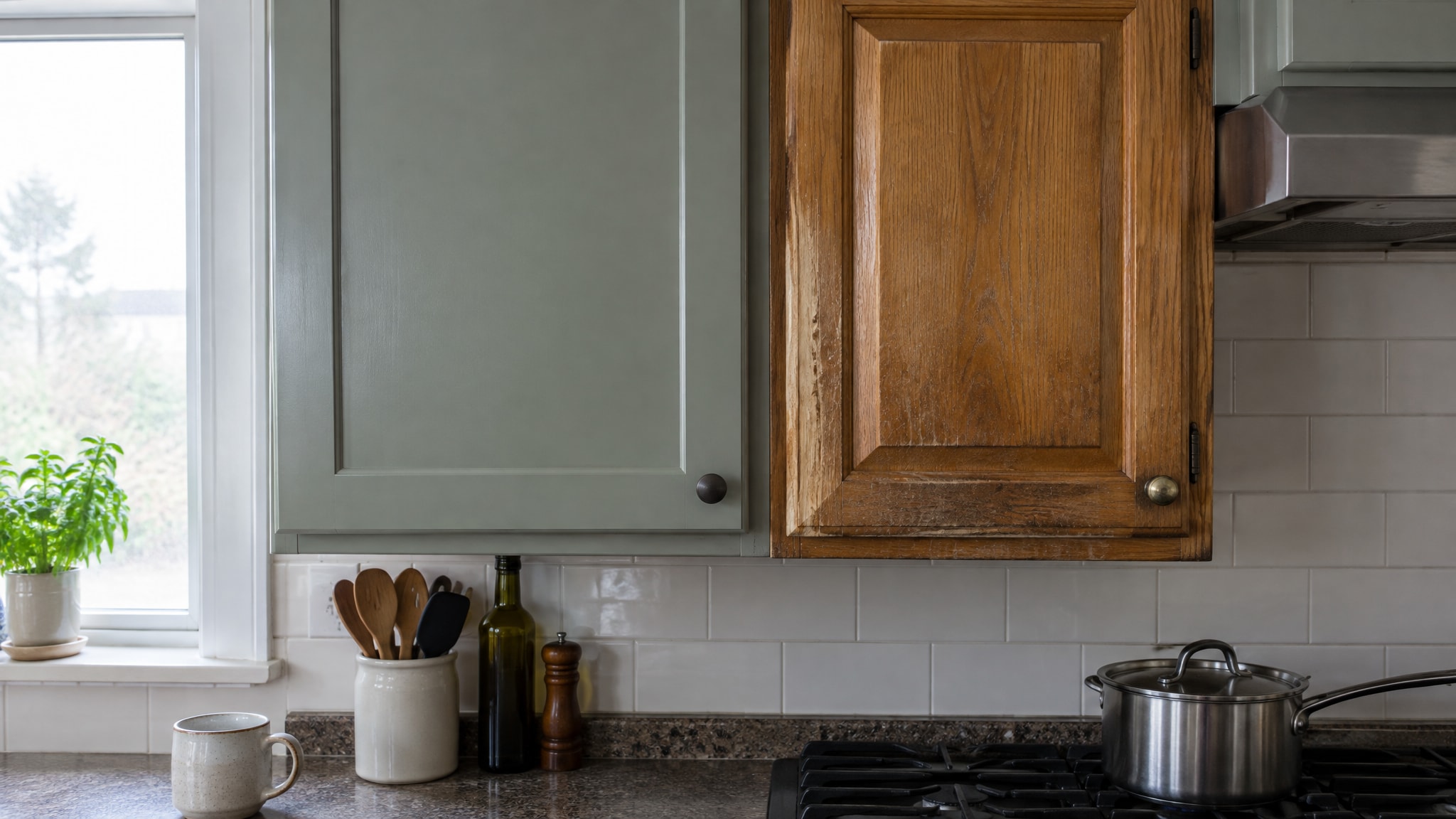
Picture one dated oak raised-panel door from the kitchen by the range. Years of cooking have left a grease film on the stiles and rails. The hinge edge is worn down to rubbed, bare wood. The door is sound, just tired, and where it gets coated will decide almost everything that follows.
The choice between shop sprayed cabinets vs painted cabinets often depends on the specific needs and conditions of your kitchen environment.
Shop-sprayed vs brushed on site
| Shop-sprayed | Brushed on site | |
|---|---|---|
| Setting | Controlled booth | Working kitchen |
| Prep | Every face and edge | Faces a rag reaches |
| Coating | Crosslinking urethane | Air-dry latex |
| Sheen | Even across door | Shifts face to edge |
| Chips | Less likely, not immune | Softer film |
Route one: brushed in the kitchen. Say a painter brushes it in place, often with the boxes still on the wall. A rag can only degrease the faces it reaches, so the hinge side and the rail edges keep their film, and the new coat bonds to grease instead of wood. Brushed latex then air-dries in a room full of steam from the stove, dust off the floor and temperature swings from morning to night. It cures unevenly. The raised panel shows brush lap marks where one stroke overlapped the last, and the sheen shifts between the flat face and the edges because a brush lays film thick in one spot and thin in the next.
When you weigh shop sprayed cabinets vs painted cabinets, think about the long-term maintenance and aesthetic appeal of each option.
From across the room it can look fine. In the light from the kitchen window, it usually does not.
Route two: sprayed in our shop. The same door comes off its hinges and gets labeled so it returns to the same opening. We degrease every face and edge, then sand. Next it goes into our controlled booth, where we spray thin, even coats of waterborne precatalyzed or crosslinking urethane lacquer. The door comes back in our 5-10 day window, and the drawer fronts follow the same route. The booth steps are laid out in our factory finish process, and the full step-by-step refinishing sequence covers removal, degreasing and sanding in order.
Four differences fall out of those steps.
Cure comes from the booth. Airflow and dust control let the wet film dry without steam, floating grit or a cold morning working against it. Adhesion comes from the prep: a door degreased and sanded on every face and edge gives the lacquer clean, scuffed wood to grip, including the hinge edge a rag never reached. Sheen comes from even spray, because the gun lays the same thin film across the panel, stiles, rails and edges, so the whole door reads as one surface and the drawer fronts match it.
Ultimately, shop sprayed cabinets vs painted cabinets presents a significant difference in how the finish adheres and lasts over time.
Chip resistance comes from the film itself. Across the coatings industry, crosslinking and precatalyzed urethanes are generally rated harder and more abrasion-resistant than air-dry brushed latex, and that gap is a big part of why shops spray them.
None of this is about the can. It is about the room and the prep.
Be precise about what differs. Waterborne is not the dividing line, because latex is waterborne too. The chemistry is crosslinking urethane versus air-dry brushed latex, and the setting is a booth versus a kitchen. Change both and you get a different result from the same oak.
One note on timing. The 5-10 days is our turnaround, not the time the film takes to reach full hardness, so for a hardness or cure figure, read the coating maker’s technical data sheet rather than trusting anyone’s memory, ours included.
Brushed vs Sprayed Cabinet Finishes: Where Chips Still Start
A sprayed urethane resists chips better than brushed latex.
Choosing between shop sprayed cabinets vs painted cabinets is essential for achieving the desired look and functionality in your kitchen.
No cabinet finish is chip-proof, ours included.
Go back to that door. Chips start at the edges, because the film is thinnest there on either method. The hinge-side edge and the rail corners tend to go first. The bottom rail takes knocks from the dishwasher door and the trash bin. On the drawer fronts, the corners take the wear from daily use.
Under ordinary use, a sprayed door is less likely to chip in those spots than a brushed one. Less likely is not immune, and we will not tell you otherwise. Read the written warranty terms to see exactly what is covered before you sign anything.
Cabinet Refinisher vs Cabinet Painter: A Side-by-Side Checklist
We are a refinisher, not a house painter. The difference shows up in six places, and you can put each one to any refinisher or house painter before you hire them. Here is how we answer.
As you investigate options, compare the pros and cons of shop sprayed cabinets vs painted cabinets to see which suits you best.
✓ Where the coat goes on. Ours: in our controlled shop booth, never in your kitchen. A painter working on site is coating in your steam, dust and temperature swings, while a shop booth holds those variables still from the first coat to the last.
✓ Door and drawer-front handling. Ours: every door and drawer front comes off, gets labeled and is reinstalled by us. Ask any painter whether the doors stay hanging on the boxes.
✓ Prep. Ours: we degrease every face and edge, then sand. We do not coat over grease and we do not skip the sanding. Ask for the prep in steps, and ask where it stops.
✓ Coating named. Ours: waterborne precatalyzed or crosslinking urethane lacquer. If the answer is just “paint,” ask for the product name and its data sheet.
✓ Sheen across doors and drawer fronts. Ours: doors and drawer fronts are sprayed under the same booth conditions, so they match. Ask how a door will match the drawer front beside it.
✓ Warranty in writing. Ours: a 3-year written warranty. Get the terms at estimate and compare them line by line.
One crucial factor is considering shop sprayed cabinets vs painted cabinets for their long-term resilience and beauty.
One more item belongs on your list. ANSI/KCMA A161.1 is the kitchen cabinet performance standard, and it includes finish tests such as adhesion. Ask any refinisher whether their finish is measured against it, and ask to see the results.
If you are still deciding whether refinishing fits your kitchen, work through our refinish-or-replace test for Boulder County kitchens.
Sprayed Cabinet Finish Durability, Backed by a 3-Year Written Warranty
Durability is only a promise when it is on paper, so we put ours there: a 3-year written warranty on our refinishes. It is not a lifetime warranty, and we do not sell it as one. Get the written terms at estimate and set them beside any other refinisher’s written terms, because what a warranty covers matters as much as how long it runs.
Additionally, think about the maintenance requirements when deciding between shop sprayed cabinets vs painted cabinets.
We have been refinishing cabinets in Boulder for 50 years, since 1976, and we are licensed and insured. When you are ready, request a free estimate. We quote only after we see your cabinets, so the number you get reflects the doors you actually have.
Frequently asked questions
Is waterborne urethane lacquer just latex paint by another name?
Ultimately, the debate of shop sprayed cabinets vs painted cabinets boils down to the nature of the finish and its application.
No. Both are waterborne, but the chemistry differs. We spray precatalyzed or crosslinking urethane lacquer, which forms a harder film than air-dry brushed latex.
Will a sprayed finish ever chip?
Yes, it can. A sprayed urethane is less likely to chip under ordinary use than brushed latex, but no cabinet finish is chip-proof. Edges, bottom rails and drawer-front corners are where chips tend to start.
Does a 5-10 day turnaround mean the finish is fully hard when the doors go back on?
In summary, the choice of shop sprayed cabinets vs painted cabinets can significantly impact your kitchen’s overall look and feel.
Not necessarily. The 5-10 days is how long the job takes from door removal to reinstall. For the finish’s full hardness, check the coating maker’s technical data sheet.
Is the 3-year warranty a lifetime warranty?
When considering shop sprayed cabinets vs painted cabinets, it’s essential to weigh all factors including cost, durability, and aesthetics.
No. It is a 3-year written warranty. We give you the terms at estimate so you can read them and compare them line by line with any other refinisher’s.
Can you give me a quote over the phone?
When making your decision, remember the distinct advantages of shop sprayed cabinets vs painted cabinets.
No. We quote only after we see the cabinets. You can request a free estimate through our contact page.
See the Best Snow Plows of 2026 ❄️
Finally, explore different options as you learn about shop sprayed cabinets vs painted cabinets, ensuring you find the best fit for your needs.
Internal Link snow removal Denver
Residential Snow Plowing in Denver →