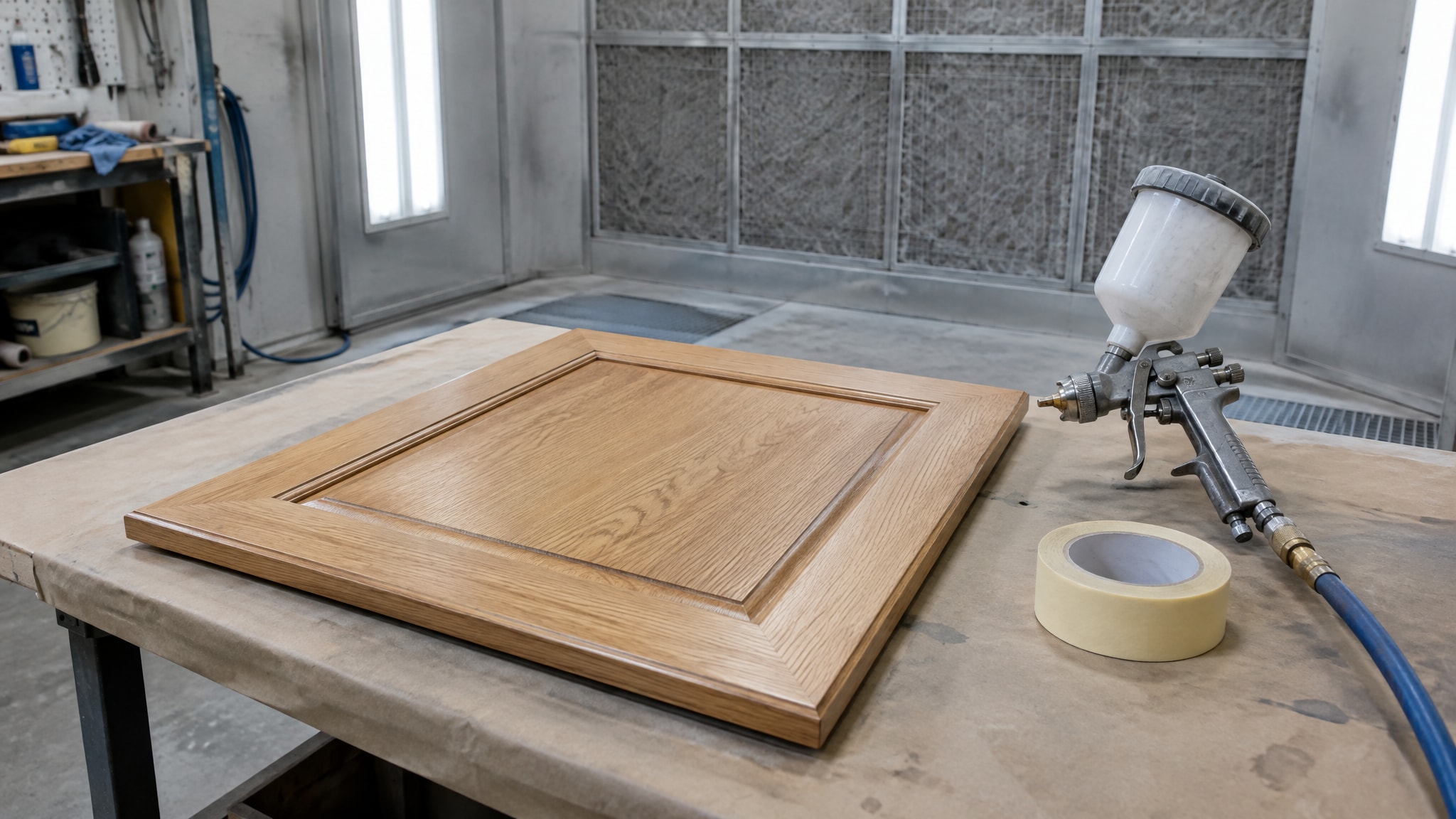
In-home light cure cabinet refinishing vs shop spraying is the choice that decides if your finish lasts. In-home light cure is cured with a light in your kitchen, shop spraying is sprayed in a shop and cured hard. Shop spraying wins for oak doors because you get a smooth factory finish with no brush marks and a 3-year warranty. The two routes differ mainly in where the door is when it gets coated. That one fact sets how much finish builds up, how well the edges are covered and how a repair gets made later.
My Review of Graco FFLP Tips for Spraying Cabinets
Key takeaways
- The two routes differ mainly in where the door is when it is coated: hung or in a masked room at home, or off the cabinet in a booth.
- On a dated oak raised-panel door, the panel recess, lower rail edge and back face are where the routes differ most, because UV light cures what it can reach.
- Our process removes and labels the doors, preps them, sprays waterborne urethane lacquer in a controlled booth and reinstalls in 5-10 days.
- Compare repair paths and written warranty terms before you sign; ours is a 3-year written warranty, and no finish is chip-proof.
- In-home work suits mostly flat doors with few recesses, while raised-panel or profiled oak suits shop spraying, at the cost of 5-10 days without doors.
We are a cabinet shop, not a house painter, and we have refinished kitchen cabinets in Boulder County since 1976. We spray in a booth. Some crews refinish in the home under UV lamps, and a good one can turn out a clean result. This article compares the two routes fairly, door by door, so you can pick the one that suits your oak.
In-home light-cure vs shop spraying: how the same door gets finished
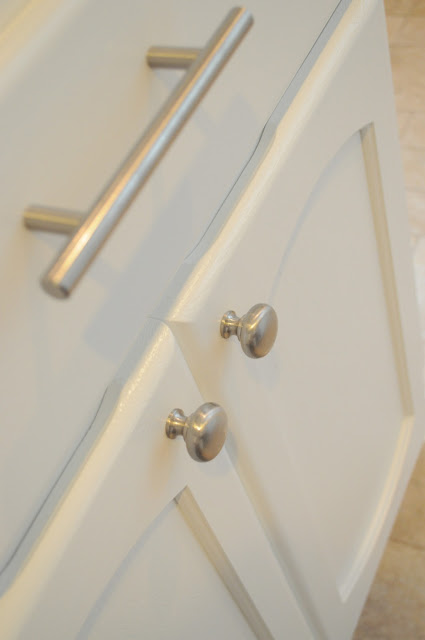
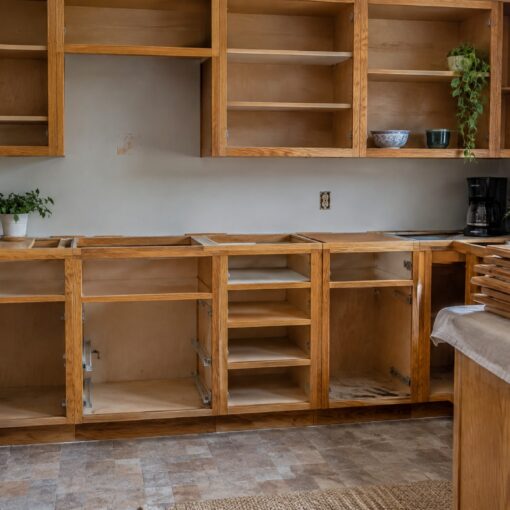
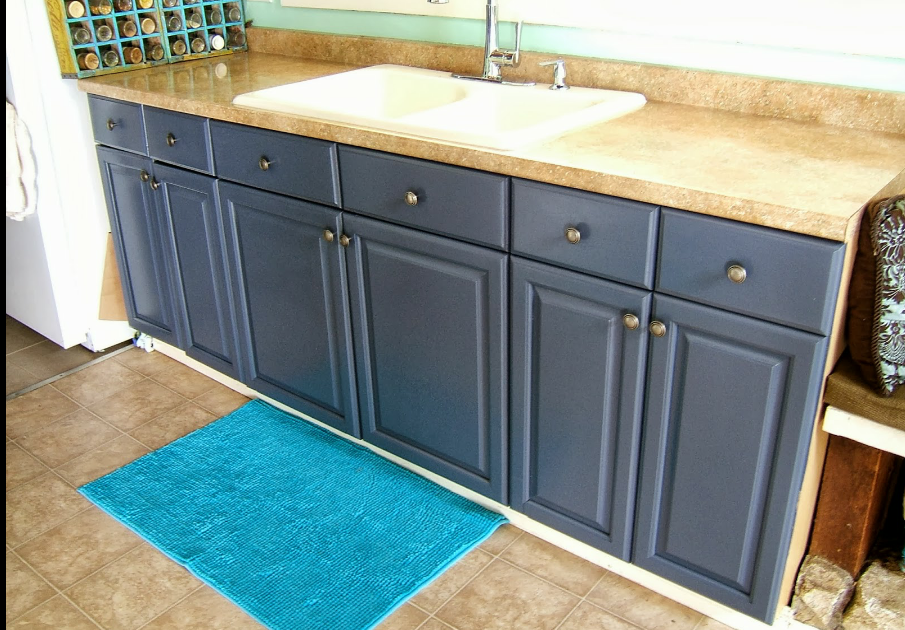
In-home light cure cabinet refinishing vs shop spraying comes down to where the finish cures. In-home light cure cabinet refinishing vs shop spraying in a shop means doors are removed, sprayed flat, and cured hard — no dust, no fumes in your kitchen, no brush marks. That is why shop spraying lasts longer on oak. Take a typical case: a dated oak raised-panel door from a Lafayette kitchen. It has a flat center panel set into a recess, a profiled edge, stiles down the sides and rails across the top and bottom. Every one of those parts has to end up with the same sheen, and the way each route gets there is different.
Same door, two routes
| In-home light-cure | Shop-sprayed | |
|---|---|---|
| Where coated | Hung, or masked room at home | Off the cabinet, in a booth |
| Recess and rail edge | Hardest to reach in place | Fully accessible with door off |
| Back face | Hard to reach on a hung door | Reachable on the bench |
| Main downside | Dust and overspray at home | Doors out 5-10 days |
The door on site
In-home light-cure refinishing, often sold as UV cure cabinet refinishing, uses a UV-curable coating. The crew applies it at your house and hardens it under UV lamps. The door may stay hung on the cabinet, or it may come down to a masked-off room in your home. Either way, the crew cleans and sands the old finish first, sprays the coat and then passes a lamp over it.
The open question is reach. UV light cures what it can reach, so the places that matter are the corner of the panel recess, the lower rail edge and the back face. A hung door has a back face you cannot get a lamp or a spray gun to. A door laid flat in a masked room gets better access, but it is still working inside your house.
The door in our booth
Our route is a sequence, and the order is the point:
- We remove the doors and drawer fronts and label each one to its opening.
- We clean and sand every piece to prepare it for finishing.
- We spray the pieces in our controlled shop booth with a waterborne precatalyzed or crosslinking urethane lacquer.
- We let the finish cure in the shop.
- We reinstall everything in 5-10 days.
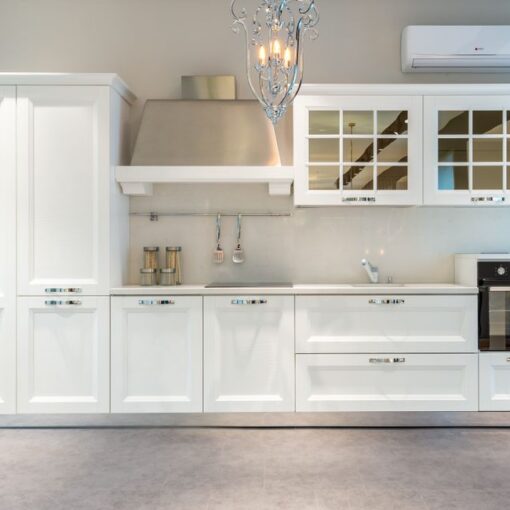
We lay out our factory finish process, step by step for readers who want the full sequence. The result is what people call a factory finish on cabinets: sprayed in a controlled space, not applied in a working kitchen. The finish is low-VOC, and we make no larger claim about it than that.
The same door, side by side
| In-home light-cure | Shop-sprayed in our booth | |
|---|---|---|
| Where the door is coated | Hung, or in a masked room at home | Off the cabinet, in a controlled booth |
| Sheen across panel, stile and rail | Depends on spray angle and lamp pass | Even coverage is easier with the door flat and open |
| Panel recess and lower rail edge | Hardest places to reach in place | Fully accessible with the door off |
| Back face | Hard to reach on a hung door | Reachable on the bench; confirm coverage in writing |
| Main downside | Dust and overspray in an occupied home | Doors out of use for 5-10 days |
The sheen row deserves a plain explanation. A raised-panel door has surfaces at several angles, and a coat that looks even on the flat rail can look thin or glossy in the recess. A sprayer working on a door that lies flat on a rack can move around it and reach every plane. A sprayer working on a door that hangs on a cabinet has to settle for the angles the room allows.
We want to be fair here, because the gap is access, not craft. A skilled crew can spray in place with proper containment, and a careful crew can do clean work in a home. In-home work also has a real advantage: your doors never leave the house, so you never have a kitchen of open boxes and no doors.
Both routes start with cleaning and sanding. Neither one is painting over the old finish, and a crew that skips the prep on either route is cutting a corner you will see later.
Finishing every side of a door is also standard woodworking practice, because a sealed door takes on and loses moisture evenly. That matters in the dry air of Boulder County, where an unfinished back face can move at a different rate than the finished front. We cannot tell you from a brochure which faces any given crew coats, so ask and get the answer written down. That includes asking us, at your estimate. The same goes for Lafayette cabinet refinishing and for every other town we serve, because the door in your kitchen decides the answer, not the zip code.
Factory finish cabinets after the install: repairs and warranty
A finish is not judged on install day alone. It is judged the first time a pot lid hits a lower door or a drawer front picks up a chip, and the question then is access: where the repair gets made, who makes it and whether the patch matches the original sheen.
You can ask each refinisher those three things before you sign. If the door can come off and go back to the shop, the repair happens in a controlled space. If the repair happens at your kitchen, ask how the crew matches the sheen on a finish that was cured under lamps or in a booth. A patch that is the right color but the wrong gloss shows up every time light crosses the door.
The warranty is where all of this gets written down. We back our work with a 3-year written warranty, and the written terms are what you should compare across refinishers, including ours. Ask any refinisher what the warranty covers, how long it runs and what voids it, and get the answers on paper. A verbal “we stand behind our work” does not count.
Even a well-made finish will chip and scratch if something hard hits it. No refinisher can promise otherwise, and none should. What you are buying is a durable finish and a clear path for dealing with damage, which is why the written terms matter more than the sales pitch. For a closer look at durability, read about how shop-sprayed and painted finishes hold up over time.
On-site cabinet refinishing pros and cons: which fits your kitchen
Each route has a real downside, and which one you can live with depends on your doors and on how your kitchen gets used.
In-home light-cure
- Pro: the doors stay in the house, and there is no trip to a shop.
- Con: the lamp and spray have to reach every surface where the cabinets hang.
- Con: dust and overspray in an occupied home.
Shop spraying
- Pro: booth control over dust, spray angle and cure.
- Pro: full coverage once the shop confirms which faces it coats.
- Pro: a 3-year written warranty from us.
- Con: your doors are out of use for 5-10 days.
The fit test comes down to the doors themselves. In-home cabinet refinishing suits mostly flat doors with few recesses, because there is less to reach and less that can go thin. Shop spraying suits raised-panel or profiled oak, because that is exactly where recesses, rail edges and back faces make access matter. If your cabinets are the dated oak raised-panel kind, the booth is the safer route.
Your kitchen matters too. If you cook every day and cannot live without doors for a week, the 5-10 days off the cabinets is a real cost, and you should plan for it with a cooler, a counter-top burner or a few easy meals. If your kitchen is the kind that can go quiet for a week, the downside mostly disappears. Louisville readers weighing the two can see how this plays out in Louisville kitchens and shop-sprayed finishes.
This comparison does not help if your cabinet boxes are damaged or your layout is failing. Refinishing changes the finish, not the structure, and it is not for kitchens that need a different design.
Once you know which kind of door you have, request a free estimate. We will look at your cabinets in person, tell you which route fits, and give you a price only after we have seen them.
Frequently asked questions
What is resurfacing kitchen cabinets?
Resurfacing, or refinishing, keeps your existing cabinet boxes and doors and renews the finish. We clean and sand the surfaces, then spray a new finish in our shop booth. It changes how the cabinets look, not their layout.
What are the downsides of painting kitchen cabinets?
A brushed or rolled coat can show brush marks and uneven sheen, especially on raised panels and profiled edges. Prep matters as much as the coating, because a finish on poorly cleaned or unsanded wood will not hold. We are not a house painter, and we spray in a booth instead.
How much does it cost to refinish a 10×10 kitchen?
We do not quote a price without seeing your cabinets, because door count, style and condition change the work. Our pricing runs about 70% below cabinet replacement. A free estimate gets you a real number.
Do both methods need sanding first?
Yes. Both routes start with cleaning and sanding, and neither one is painting over the old finish. A crew that skips prep on either route is cutting a corner that shows up later.
How long are my doors out of use with shop spraying?
Plan on 5-10 days from removal to reinstall. We label each door to its opening so everything goes back where it came from.
In-home light cure cabinet refinishing vs shop spraying is the choice that decides if your finish lasts.
In-home light cure cabinet refinishing vs shop spraying comes down to where the finish cures.
In-home light cure cabinet refinishing vs shop spraying in a shop means doors are sprayed flat and cured hard.
In-home light cure cabinet refinishing vs shop spraying saves you fumes, dust, and brush marks in your kitchen.
In-home light cure cabinet refinishing vs shop spraying is best with a 3-year warranty on oak doors.
In-home light cure cabinet refinishing vs shop spraying — if you want a factory finish, choose shop spraying.
In-home light cure cabinet refinishing vs shop spraying is the smart way to get a factory finish.
In-home light cure cabinet refinishing vs shop spraying starts with removing doors so they can be sprayed flat.
In-home light cure cabinet refinishing vs shop spraying uses a stain-blocking primer so old oak never bleeds through.
In-home light cure cabinet refinishing vs shop spraying finishes with a hard topcoat that wipes clean.
In-home light cure cabinet refinishing vs shop spraying is best in satin — white, greige, and soft green are most popular.
In-home light cure cabinet refinishing vs shop spraying — if you want no brush marks, get a shop-sprayed quote in writing.