Twenty twenty-six, poly, Y2K. The title sounds like a band name, but it’s shop talk. This is a 2026 look at the Y2K-era kitchen, built roughly between the late 1990s and the early 2000s, and its “poly”: the amber polyurethane that went over honey oak and has been yellowing ever since.
Key takeaways
- Y2K-era solid oak boxes in good shape are usually worth refinishing, because the amber poly finish is what has failed, not the cabinets.
- We spray doors and drawer fronts with waterborne precatalyzed or crosslinking urethane lacquer in a shop booth, and reinstall them in 5-10 days.
- Oak grain will not disappear under primer and lacquer, so you choose between leaving it visible or filling it before spraying starts.
- No finish is chip-proof, and our warranty is 3 years in writing, not a lifetime.
- Our pricing runs about 70% below replacement as a general rule, but we quote only after seeing your cabinets.
We have refinished kitchen cabinets since 1976, and this is the job we see most in Boulder County homes. If your oak cabinets are solid but the color says 2001, here is what the fix looks like from start to finish.
Cabinet Refinishing and Painting in Longmont, Colorado: Fixing the Y2K Polyurethane Oak Kitchen
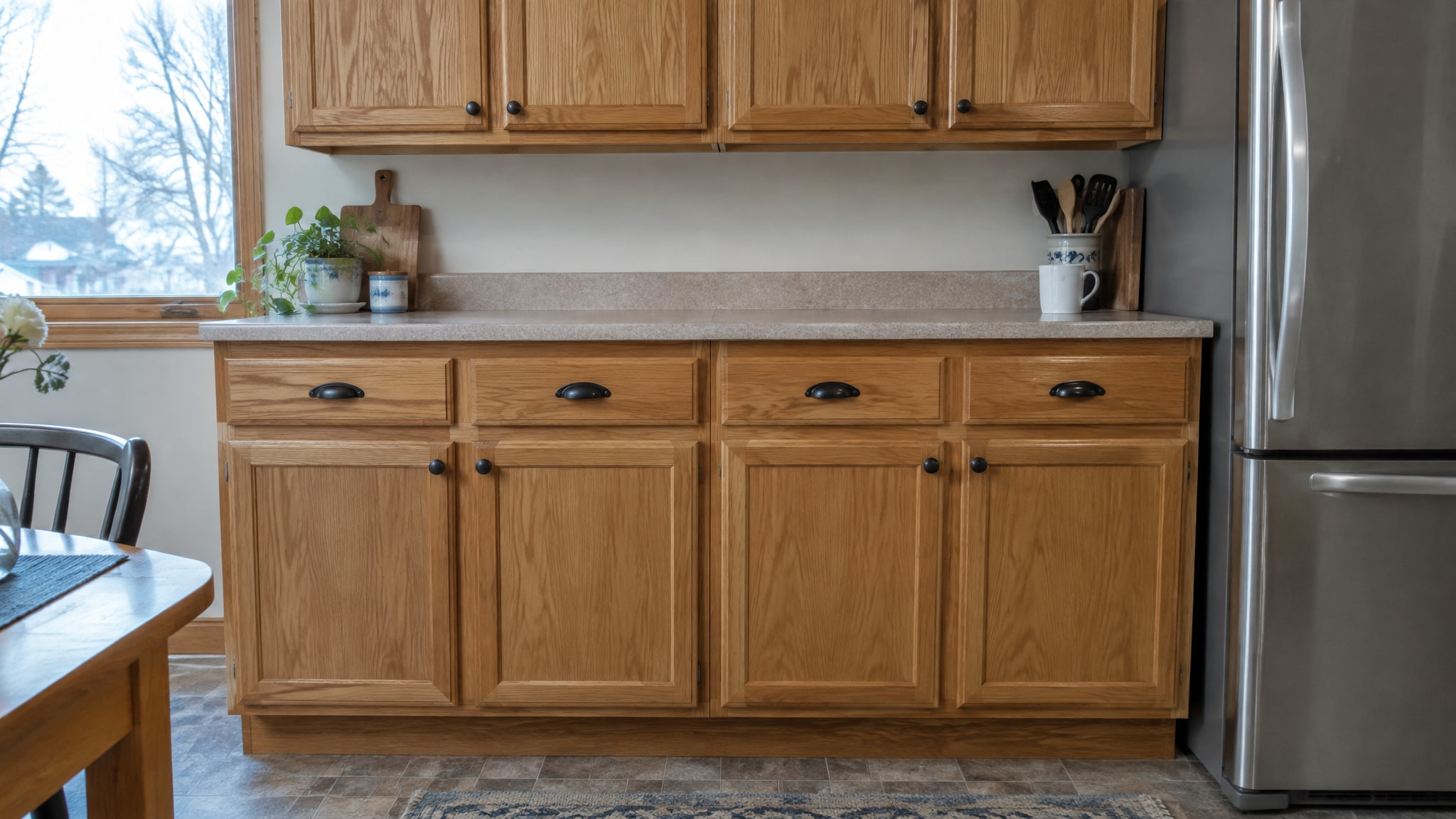
Picture a typical Longmont home built around 2000. The cabinets are solid oak, and the boxes are sound: doors hang straight, drawers slide, nothing sags. The finish is what has failed.
Three ways to redo oak cabinets
| Our shop-sprayed | Brushed paint job | In-home light-cure | |
|---|---|---|---|
| Where it’s done | Our shop booth | In your home | In your home |
| Finish | Waterborne urethane lacquer | Brushed latex paint | Light-cure coating |
| Application | Sprayed, factory-style | Brushed on | Cured in place with light |
| Warranty | 3-year written | Ask to see it in writing | Ask to see it in writing |
Polyurethane from that era ambers with age, and the honey stain underneath adds to the warm cast. Twenty-odd years later, the poly has gone orange. It is worn thin around the pulls and along the sink base, where hands and water hit it every day. The oak grain is heavy and open, so every door reads as dated.
Solid oak boxes are the costly part of any kitchen, and yours are in good shape, so cabinet refinishing usually makes more sense than tearing them out and starting over. If you are still weighing that call, we lay out refinishing vs replacing in Boulder County separately.
Here is how we run that kitchen, in order:
- Remove and label. Doors and drawer fronts come off, and every piece is labeled so it goes back exactly where it came from.
- Degrease. Cooking film builds up near the range and sink, and sanding over it grinds it into the wood, so we clean it off first.
- Sand. We never paint over unsanded cabinets. Sanding takes off the gloss and the worn poly, including the bare spots at the pulls, so the primer has something to grip.
- Decide the grain. We fill it or leave it showing, your choice (more on that below).
- Prime. Primer goes on next to give the lacquer a uniform base.
- Spray. Doors and drawer fronts get waterborne precatalyzed or crosslinking urethane lacquer, sprayed in our controlled shop booth.
- Reinstall. Everything goes back on in 5-10 days.
Our step-by-step refinishing guide goes deeper on each stage if you want the detail.
The grain decision
Oak grain is the one place we won’t tell you what you want to hear. Oak has open pores, and a coat of primer and lacquer will not make them disappear.
You have two honest options. Leave the grain, and it shows through the new color as texture, a look many people like on a white or soft gray oak kitchen. Or we fill the grain first, which adds a step and gives you a smoother surface, closer to what most people picture when they say painted cabinets.
We ask which look you want before we start, because it is much harder to change your mind once the doors are sprayed.
Why the doors leave your house
This is not a one-day job.
Expect 5-10 days from the day the doors come off to the day they go back on. The doors and drawer fronts spend that time in our shop, where the lacquer cures in a controlled booth instead of a kitchen full of dust and cooking steam, and a finish rushed past that point is not one we would put our warranty behind.
If you are searching for cabinet refinishing and cabinet painting in Longmont, the question that matters most is where the finish is made. Here is how the options compare:
| Our shop-sprayed finish | Brushed paint job | In-home light-cure | |
|---|---|---|---|
| Where it’s done | Our shop booth | In your home | In your home |
| Finish | Waterborne urethane lacquer | Brushed latex paint | Light-cure coating |
| Application | Sprayed, factory-style | Brushed on | Cured in place with light |
| Warranty | 3-year written | Ask to see it in writing | Ask to see it in writing |
We cover the comparison at more length in shop-sprayed cabinets vs painted.
We are not a house painter.
A house painter brushes latex paint onto cabinets that are still hanging in your kitchen. Cabinet doors take more punishment than almost any other surface in the house: hands, pulls, steam, spills. Sprayed lacquer lays down flat with no brush marks, and crosslinking urethane builds a tougher film than brushed paint. That is why we spray in a booth and don’t brush in your kitchen.
Waterborne urethane also doesn’t carry the amber cast of the old poly, so the color you pick is the color you keep.
What this does and doesn’t do
No finish is chip-proof.
A dropped pan will mark ours too. That is why we back the work with a 3-year written warranty, and why we describe it as exactly that: three years, not a lifetime. Refinishing also changes color and finish, not the shape of the kitchen. It keeps your door style and layout, and if your boxes are damaged or sagging, it is not the right fix.
Here is what your oak kitchen comes out with:
- ✔ Clean, even color with the amber gone
- ✔ Worn spots at the pulls and sink base refinished along with everything else
- ✔ The grain look you chose
- ✔ The same sheen on every door and drawer front
- ✔ A 3-year written warranty
We don’t quote prices sight unseen. We look at your cabinets, then give you a number. As a general rule, our pricing lands about 70% below replacing the cabinets, though your quote depends on what we find in your kitchen. For how that pricing works, see cabinet refinishing cost in Boulder County. For the local picture, our page on cabinet refinishing in Longmont covers the area.
Why Longmont Homeowners Are Updating Y2K Kitchens in 2026
The usual story is simple: the boxes are sound and the finish is dated. Nobody wants to pay to rip out good solid oak because the color went orange, and you probably don’t either.
Refinishing keeps the cabinets you have and changes how they look, which is why Y2K kitchens are a natural fit. A kitchen that felt warm in 2001 can read as tired today, and a new color fixes that without touching the layout you already live with.
Some homeowners take it one step further with a two-tone kitchen. A painted perimeter with a different color on the island is a popular direction, and it works well on oak because the island becomes a feature rather than an afterthought. Tell us what you are picturing and we will talk through what is workable on your cabinets.
Our waterborne finish is low-VOC. That does not mean zero chemicals, and we don’t make health claims about it. It means a different, lower-emission product than the solvent finishes of the Y2K era.
We serve Boulder County, Longmont included.
What to Ask Before You Hire a Cabinet Refinisher
Before you sign with a refinisher or a house painter, get straight answers on the points below, because the answers separate a factory-style finish from a repaint. Ask every company the same things and compare what you hear.
- Location. Find out whether the doors are sprayed in a shop booth or in your kitchen. Ours are sprayed in our controlled shop booth.
- Product. Get the exact finish named. We use waterborne precatalyzed or crosslinking urethane lacquer.
- Days. Get a day count, not a promise of “done by tomorrow.” Ours is 5-10 days.
- Prep. Confirm that degreasing and sanding are included. We never paint over unsanded surfaces.
- Warranty. Get it in writing, with the term spelled out. Ours is a 3-year written warranty.
- Credentials. Ask about licensing and insurance, and how long the company has been around. We are licensed and insured, and we have worked in this trade since 1976, which is 50 years.
If you want our answers applied to your own cabinets, request a free estimate and we will come look at them.
Frequently asked questions
Can I refinish oak cabinets with yellowed polyurethane instead of replacing them?
Yes, if the boxes are sound. Doors that hang straight and drawers that slide mean the finish is the problem, and we fix that by degreasing, sanding, priming and spraying. If the boxes are damaged or sagging, refinishing is not the right fix.
Will the oak grain show through after refinishing?
It can. Oak has open pores, and primer and lacquer alone won’t hide them. You can leave the grain visible as texture, or we can fill it first for a smoother surface, and we ask which look you want before we start.
How long will my doors be gone?
The whole job runs 5-10 days from the day the doors and drawer fronts come off to the day they are reinstalled. They spend that time in our shop, where the finish is sprayed and cured in a controlled booth. We don’t offer one-day refinishing.
What does your warranty cover and how long does it last?
We give a 3-year written warranty on the factory finish. It is not a lifetime warranty, and no finish is chip-proof, so a hard knock can still mark any cabinet.