
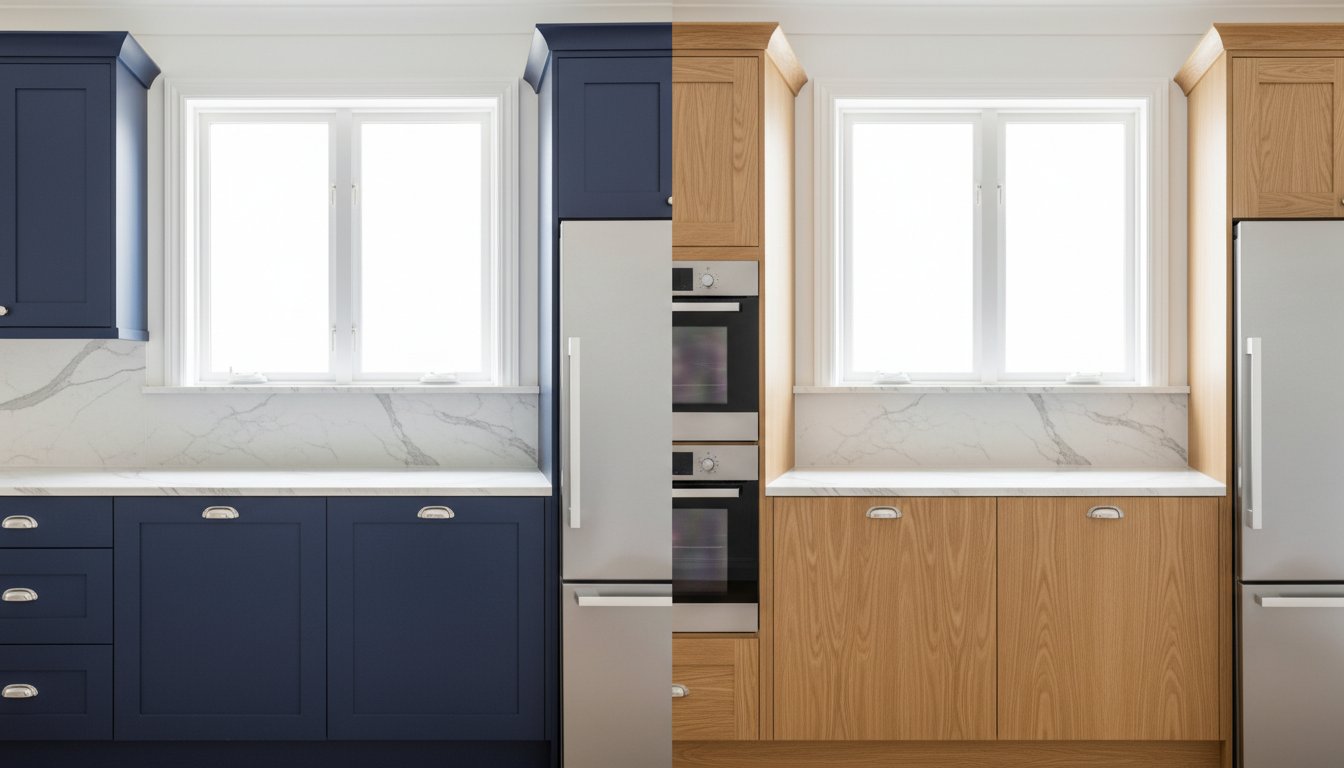
Thinking about updating your kitchen cabinets but feeling stuck? You’re not alone. Choosing between cabinet refinishing vs refacing is a common dilemma for homeowners. The terms sound similar, but the process, cost, and final result are vastly different. Many worry about making the wrong choice, wasting money on a short-term fix, or not understanding which option provides the best long-term value for their home.
No, you don’t have to, and that is a major benefit of choosing to refinish. Our process is designed to protect your existing countertops. However, many homeowners find that updating their cabinets is the perfect time to complete the kitchen’s transformation. If you’re considering this, you can explore Quartz Countertops options that pair beautifully with a new cabinet finish. There is no need for the extra cost or demolition associated with removing your countertops, which is often required for a full cabinet replacement project.
This is a specialized job, and making an informed decision is the most vital factor for success. This guide provides a direct, no-nonsense comparison to clear up the confusion. We break down everything you need to know: the step-by-step process for both options, a realistic look at costs, and the key differences in durability. You’ll get a straightforward, side-by-side look so you can confidently decide which kitchen cabinet upgrade is the right investment for your home and your budget.
Key Takeaways
- Understand the core difference between refinishing and refacing to see which method works with your existing kitchen cabinets.
- Compare the cost of each option to see how refinishing can deliver a high-end look for a fraction of the price of a full refacing project.
- The debate over cabinet refinishing vs refacing often comes down to durability. Discover why a professional factory finish lasts longer than you might think.
- Get a clear decision-making guide to determine if your cabinets are a better fit for a complete refacing or a professional refinishing.
Refinishing vs. Refacing: Understanding the Core Difference
When planning a kitchen update, the debate over cabinet refinishing vs refacing is one of the first hurdles. To simplify it, think of it this way: refinishing is like restoring the original skin, while refacing is a complete transplant. Both are excellent alternatives to a full, costly remodel because they utilize your existing kitchen cabinet boxes, which are typically well-built and structurally sound. The right path for your home depends on the condition of your cabinets, your budget, and the final look you want to achieve.
This short video provides a great visual breakdown of the two processes:

What is Cabinet Refinishing?
Cabinet refinishing is a surface-level transformation that focuses on changing the color and finish of your existing cabinet doors, drawer fronts, and frames. It is a highly detailed process that requires professional execution to avoid failure. The steps include intensive cleaning and degreasing, sanding down the old finish, priming, and then spraying multiple coats of a durable, industrial-grade coating. The goal is to create a smooth, resilient, factory-like finish that looks brand new. Refinishing is the perfect choice for homeowners who are happy with their cabinet style but want a modern color update and to erase years of minor wear and tear.
What is Cabinet Refacing?
Cabinet refacing is a more comprehensive overhaul. This process involves completely removing and replacing your old cabinet doors and drawer fronts with new ones. To create a seamless look, a thin veneer of matching wood or laminate is applied directly over your existing cabinet boxes. This method allows for a total style transformation—you can switch from dated arched panels to a clean, modern Shaker style, for example. New hinges, handles, and pulls are typically part of the package. Refacing is a more invasive and expensive project, but it delivers the look of a brand-new kitchen at a fraction of the cost of a full replacement.
At-a-Glance Comparison: Refinishing vs. Refacing Table
Still weighing your options? This quick comparison table breaks down the essential differences to help you make an informed decision for your project.
| Feature | Cabinet Refinishing | Cabinet Refacing |
|---|---|---|
| Process | Sand, prime, and spray existing doors and frames. | Replace doors/fronts; apply new veneer to frames. |
| Cost | Lower cost (typically 30-50% less than refacing). | Higher cost due to new materials and more labor. |
| Timeline | Faster, usually 3-5 days. | Longer, usually 5-7 days or more. |
| Style Change | Changes color and finish only. The door style remains the same. | Allows for a complete change of style, material, and color. |
| Best For | Structurally sound cabinets with a style you already like. | Cabinets with an outdated style but good, solid boxes. |
The Process & Timeline: What to Expect in Your Kitchen
When you’re deciding on cabinet refinishing vs refacing, understanding the actual work involved is a vital factor. The process, level of disruption, and total project time differ significantly between the two. A professional job, whether refinishing or refacing, depends on a meticulous process. Here’s a straightforward breakdown of what you can expect in your kitchen.
The Professional Refinishing Process: All About Prep
A high-quality refinishing job is 90% preparation. This is not a simple paint job, and it’s what separates true cabinet specialists from amateur house painters. The finish will fail without proper prep.
- Step 1: Cleaning & Disassembly: We start with a thorough cleaning and degreasing of all surfaces to remove years of kitchen grime. All doors, drawers, and hardware are carefully removed.
- Step 2: Meticulous Sanding: Every square inch of your cabinet boxes, doors, and drawers is sanded. This creates the essential “tooth” that allows the primer to bond permanently. Skipping this guarantees chipping and peeling.
- Step 3: Priming & Painting: A high-adhesion primer is applied, followed by multiple coats of a durable, factory-grade topcoat. We spray these coats for a flawless, non-streaky finish that looks brand new.
The Refacing Process: New Doors and Veneers
Refacing is a more invasive process that involves replacing the “skin” of your cabinets. While it provides a new style, the quality of the installation is critical for a long-lasting result.
- Step 1: Measure & Order: A technician takes precise measurements of your cabinet boxes, doors, and drawer fronts. New, custom-made components are then ordered from a manufacturer.
- Step 2: Demolition & Prep: Your old doors and drawer fronts are removed and discarded. The surfaces of your cabinet boxes are then prepared for the new material.
- Step 3: Veneer & Installation: A new wood or laminate veneer is applied directly over your existing cabinet boxes. The new doors, drawer fronts, hinges, and hardware are then installed. Proper veneer application is crucial to prevent peeling and bubbling.
Project Duration: How Long Will Your Kitchen Be Out of Commission?
Kitchen downtime is a major concern for homeowners. Refinishing is almost always the faster option. A professional refinishing project is typically completed in 3 to 5 days. We minimize the mess and fumes in your home by taking doors and drawers off-site to be sprayed in our controlled shop environment. Refacing, on the other hand, takes longer. After the initial measurements, you often have to wait several weeks for your new doors to be manufactured. Many homeowners find this timeline difference to be a key deciding factor, a point often emphasized in detailed Cabinet Refacing vs. Refinishing comparisons. The final installation may only take a few days, but the total project duration from start to finish is much longer.

Cost Breakdown: Which Option Offers Better Value?
For most homeowners, the decision between cabinet refinishing vs refacing comes down to budget. Let’s be direct: cabinet refinishing is significantly more affordable. The key difference lies in what you’re paying for—skilled labor versus new materials. Understanding this distinction is crucial for determining not just the upfront cost, but the long-term value and return on your investment.
Analyzing the Cost of Cabinet Refinishing
Cabinet refinishing is a service-driven process. The cost is almost entirely based on the skilled labor required for meticulous preparation, sanding, priming, and applying a durable, factory-grade finish. Because we are revitalizing your existing high-quality cabinet doors and boxes, you aren’t paying for expensive new materials. This is why a professional refinishing job often costs 40-60% less than quality refacing. The price is determined by the scope of the work (your cabinet count), not a massive materials bill. Get a fast, free quote for your cabinet refinishing project.
Understanding the Price of Cabinet Refacing
With cabinet refacing, the primary costs are new materials. You are purchasing an entirely new “skin” for your kitchen. The major expenses include:
- New cabinet doors and drawer fronts
- Veneer to cover the cabinet boxes
- New hinges, knobs, and pulls
The price fluctuates dramatically based on the style and quality of these materials—solid wood doors cost far more than laminate. On top of materials, you also pay for the significant labor to install everything correctly. This is why refacing can quickly approach 70-80% of the cost of a full cabinet replacement.
When evaluating cabinet refinishing vs refacing, the value proposition becomes clear. If your cabinet layout works and the boxes are structurally sound, refinishing delivers a transformative, like-new look for a fraction of the price. You invest in craftsmanship that enhances the assets you already own, providing an unbeatable return on investment for your kitchen update.
Durability & Aesthetics: Which Looks Better and Lasts Longer?
When it comes to the crucial debate of cabinet refinishing vs refacing, homeowners often worry about the final appearance and how long it will hold up. Many mistakenly believe refinishing is just a coat of paint. This is incorrect. A professional refinishing job delivers a smooth, durable, factory-like finish that transforms your kitchen, while refacing introduces new materials with their own set of vulnerabilities.
The aesthetic choice depends on your goals. Refinishing allows for unlimited color customization while preserving the character of your existing cabinets. Refacing offers a completely new door style, but the final look is only as good as the veneer applied to your cabinet boxes.
Durability of a Professional Refinish
A professional refinish is engineered for the high-traffic environment of a kitchen. We don’t use brushes and rollers like a house painter. We use industrial-grade coatings that are spray-applied to create a flawless, hardened shell. This process ensures a finish that not only looks brand new but performs that way for years.
- Factory-Grade Toughness: Our spray-applied finishes resist chipping, peeling, and staining far better than any hand-painted surface.
- Easy to Clean: The non-porous surface is completely washable, standing up to daily kitchen splatters and grease.
- Lasting Quality: When done correctly, a professional refinish can last 10 years or more, because it bonds directly to your high-quality existing solid wood cabinets.
Longevity of Refaced Cabinets
While the new cabinet doors you get with refacing are as durable as any new door, the real concern lies with the cabinet boxes. To match the new doors, thin layers of veneer or laminate are glued over your existing cabinet frames. This is the system’s biggest weak point.
Over time, especially in areas with heat and moisture like near a dishwasher or stove, this veneer can fail. Poor adhesion or low-quality materials (like thermofoil) can lead to bubbling, chipping, and peeling edges, revealing the old cabinet surface underneath and creating a costly problem to fix.
Ultimately, the choice in the cabinet refinishing vs refacing discussion comes down to proven reliability versus potential risk. A professional refinish leverages the proven strength of your existing cabinets and enhances them with a modern, incredibly durable finish. You get a customized, brand-new look that is built to last. To see what a true professional finish looks like, view our gallery at cabinetrefinishing.info.
The Final Verdict: Which Is Right for Your Boulder Kitchen?
Choosing between cabinet refinishing vs refacing comes down to the current condition of your cabinets and your ultimate goals. Both can update your kitchen, but they solve different problems. This guide will help you make a clear-headed decision for your Boulder home, ensuring you invest your money wisely for a result that lasts.
Choose Cabinet Refinishing If…
For most homeowners with solid, well-built cabinets, refinishing is the smarter investment. It delivers a factory-quality finish for a fraction of the cost of replacement or refacing. You are an ideal candidate for cabinet refinishing if:
- Your cabinet boxes and doors are structurally sound, especially if they are solid wood or high-quality plywood.
- You are satisfied with your current kitchen layout and don’t need to change the configuration.
- You want a significant color or finish change to achieve a modern, updated look, like going from dated oak to a clean, durable white or gray.
- You are looking for the highest possible return on your investment when it comes to boosting home value.
Consider Cabinet Refacing If…
We believe in being straightforward. Refacing is the correct choice in specific situations where the cabinet doors themselves are the core problem. While it’s more expensive, sometimes it is the only practical option. Consider refacing only if:
- Your cabinet doors are broken, warped, or have severe water damage that cannot be properly repaired.
- You absolutely cannot stand the physical style of your doors (like deep cathedral arches) and want a completely different profile, such as a modern Shaker style.
- Your cabinets are made of cheap, peeling thermofoil or laminate that cannot be properly sanded and prepped for a durable paint finish.
Why We Specialize in Refinishing
The debate over cabinet refinishing vs refacing often overlooks a key fact: many older Boulder homes were built with high-quality, custom cabinet boxes that are far superior to today’s particleboard alternatives. Tearing them out or covering them up is a waste of quality craftsmanship.
We specialize in refinishing because it preserves that original quality while providing a stunning, modern transformation. It is a more sustainable and cost-effective solution that leverages the best parts of your existing kitchen. Our meticulous preparation process ensures a finish that looks and feels new, without the expense and disruption of a major refacing project. Trust Boulder’s refinishing experts to transform your kitchen.
Making the Smart Choice for Your Boulder Kitchen
The debate over cabinet refinishing vs refacing ultimately comes down to your budget and your goals. For homeowners who like their kitchen’s layout, refinishing provides a stunning, high-end transformation for a fraction of the cost. It delivers maximum impact by updating the color and finish of your existing, quality cabinets.
Don’t trust this important job to an amateur house painter. With over 38+ years of local experience serving Boulder and surrounding communities, we know what it takes to get the job done right. We specialize in creating durable, factory-like finishes that are built to last. Our meticulous preparation process is the key to a flawless result that cheap shortcuts can never replicate.
If you value quality and want a kitchen you can be proud of, the choice is clear. Ready for a change? Get your fast, no-obligation refinishing quote today! Transform your kitchen with confidence.
Frequently Asked Questions
Is cabinet refacing the same as replacing cabinets?
No. Cabinet refacing is a cosmetic fix where new veneer is applied over your existing cabinet boxes and new doors are installed. The core structure of your old cabinets remains. A full replacement is a complete tear-out and installation of new cabinet boxes. Refacing is less disruptive than a replacement but often costs much more than refinishing and does not improve the cabinet interiors.
Can you refinish any type of kitchen cabinet, like laminate or thermofoil?
This is a vital factor in the cabinet refinishing vs refacing decision. Solid wood cabinets are the best candidates for a high-quality refinishing job. Laminate and thermofoil are essentially plastic surfaces that cannot be sanded and stained like wood. While they can be painted, it requires specialized bonding primers and meticulous preparation. Without an expert process, the paint will quickly chip and peel from these non-porous surfaces.
Will professionally refinished cabinets look cheap or painted?
Absolutely not. That “painted” look comes from house painters using brushes, rollers, and the wrong products. We are cabinet refinishing specialists. Our process involves spraying multiple coats of premium, cabinet-grade lacquer in a controlled environment to achieve a durable, flawless, factory-like finish. Your cabinets will look brand new and custom-made, not like a DIY project. Quality preparation is the key difference.
Which service adds more resale value to my home?
A professional cabinet refinishing job provides one of the highest returns on investment for any kitchen update. It delivers the look of a brand-new kitchen for a fraction of the cost of refacing or replacing, which appeals directly to potential buyers. Because we are restoring and enhancing your quality original cabinets, it is viewed as a high-end upgrade, not a cheap cover-up that refacing can sometimes appear to be.
How do I clean and maintain my newly refinished cabinets?
Maintaining your new finish is simple. Use a soft, lint-free cloth dampened with a mild solution of soap and water for regular cleaning. Avoid using abrasive sponges, harsh chemical cleaners, ammonia-based products, or wax polishes, as these can damage the protective topcoat. Clean up spills, especially grease, promptly. With this basic care, your durable finish will look great for years to come.
Do I need to replace my countertops if I refinish my cabinets?
No, and that is a major benefit of choosing to refinish. Our professional process is designed to work around your existing kitchen layout. We meticulously mask and protect your countertops, backsplash, floors, and appliances. There is no need for the extra cost or demolition associated with removing your countertops, which is often required for a full cabinet replacement project.