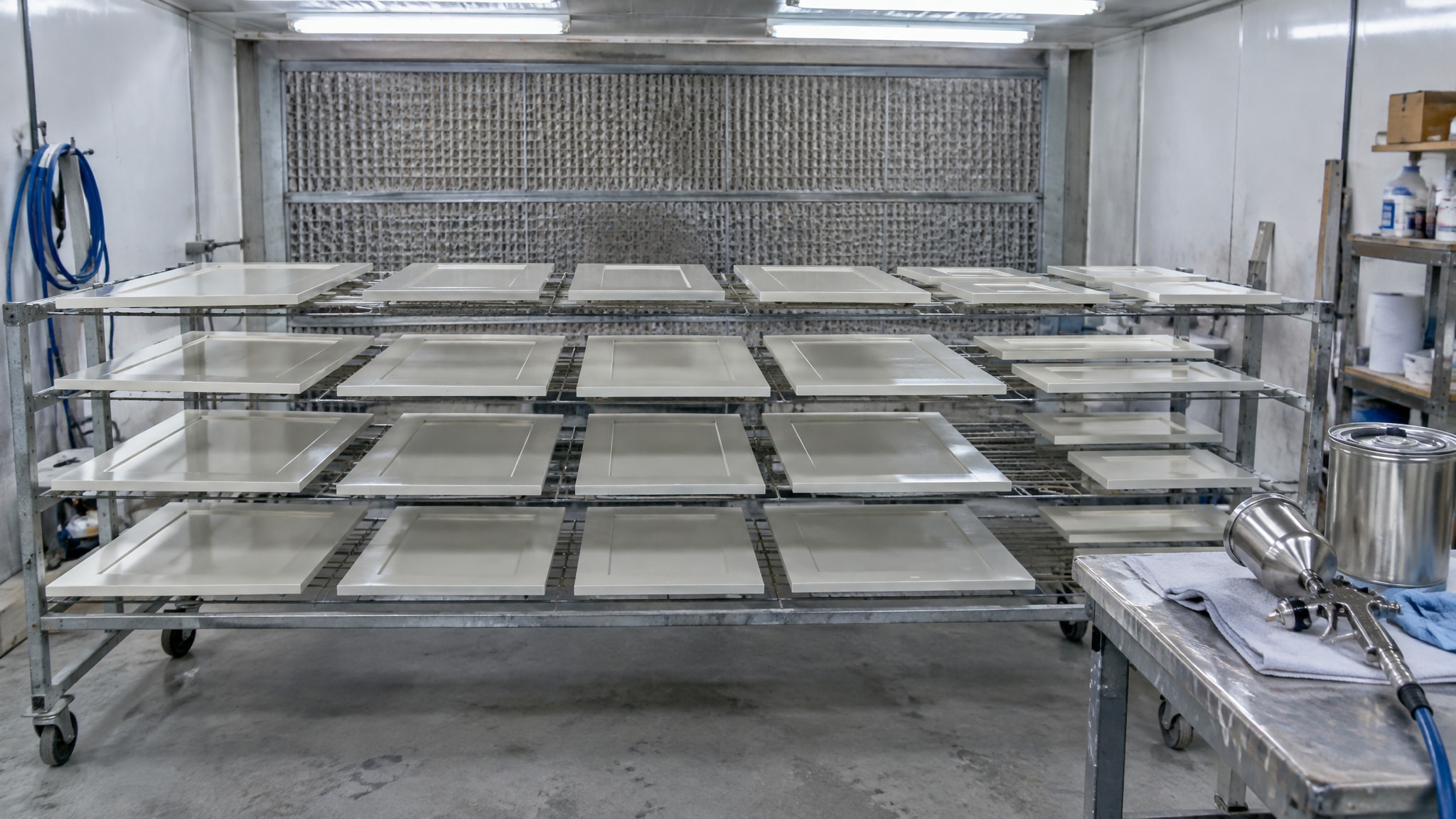
Low-VOC cabinet refinishing in Boulder happens in our shop, not in your kitchen. We pull the doors and drawer fronts, spray them in a controlled booth, and bring them back finished.
Key takeaways
- Low-VOC refinishing here means doors and drawer fronts are sprayed in our shop booth with waterborne precatalyzed or crosslinking urethane lacquer, then reinstalled in 5-10 days.
- Precatalyzed lacquer has its hardener built in at the factory, while crosslinking urethane is usually a two-part system mixed before spraying; both cure into a chemically linked film.
- Spraying stays out of your kitchen because a booth contains overspray, allows flat handling, and keeps temperature, airflow and mixed-material working time under control.
- Low-VOC describes the coating only: it doesn’t mean zero chemicals, odor-free work, a health benefit, or cabinets that never chip or scratch.
- The estimate is free, we price only after seeing your cabinets, and the work carries a 3-year written warranty.
That one fact explains most of what you’re paying for. The coating matters, but the place it’s applied matters just as much.
How Low-VOC Cabinet Refinishing Works in Our Boulder Shop
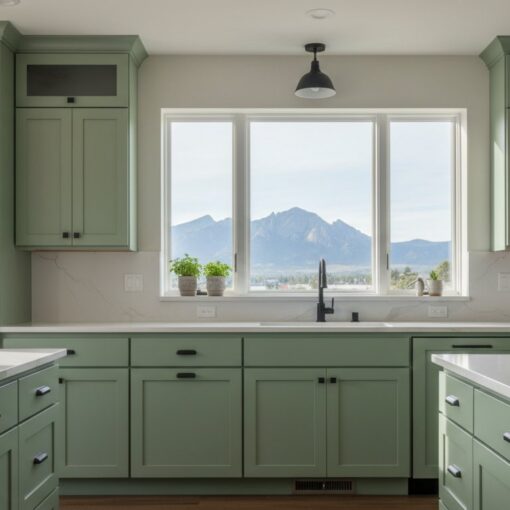
Picture a typical Boulder kitchen. The cabinet boxes are solid, but the honey-oak raised-panel doors and drawer fronts look dated, and the owner wants an even, factory-smooth finish without paying to replace everything. Here is how we handle that kitchen.
Solvent-borne vs waterborne lacquer
| Solvent-borne | Waterborne urethane | |
|---|---|---|
| Carrier | Solvents | Mostly water |
| VOC content | Generally higher | Generally lower |
| Cure | Dries as solvent evaporates | Chemical reaction, linked film |
- We label every door and drawer front to its opening and take them out. The boxes stay where they are.
- In the shop, we sand and clean every piece. Nothing gets painted over.
- We spray the doors flat in our booth with a waterborne precatalyzed or crosslinking urethane lacquer.
- The film cures in the shop.
- We reinstall everything in 5-10 days.
The homeowner gets a smooth, brush-mark-free surface. The oak grain pattern can still read through a finish like this, because we refinish the cabinets you have and don’t swap them for new ones.
What those coating terms mean
“Lacquer” is the trade word for these coatings. It doesn’t mean the old solvent lacquer your parents had on their furniture. Here is what each term in our finish actually says.
- Waterborne: the carrier that holds the finish is mostly water rather than solvent. A waterborne cabinet finish is the starting point for anything we’d call low-VOC.
- Precatalyzed: the hardener is built in at the factory. With precatalyzed lacquer, cabinets get a film that cures by chemical reaction as well as by drying.
- Crosslinking urethane: usually a two-part system, mixed right before spraying. As it cures, the film links into a network.
Both types cure into a chemically linked film. They don’t simply dry and sit there.
Crosslinking is the main source of the film’s resistance to everyday wear, and good prep is what lets that film grip the wood. A hot pan handle, a pet’s claws and a kid’s backpack are still hard on any finish, so we don’t tell anyone cabinets will never chip or scratch. What we do put in writing is a 3-year warranty. If you want the longer argument, we lay out shop-sprayed versus painted cabinets, and which lasts longer in a separate piece.
Why the Spraying Happens in Our Booth, Not Your Kitchen
Overspray is the first reason. Spraying in an occupied kitchen sends fine mist onto floors, walls, counters and appliances, and a booth is built to contain it.
Handling is the second. We lay doors flat, which gives even coverage with the fewest drips and no brush marks. You can’t lay a hung door flat.
The third reason is the material itself, and it takes a little explaining. Waterborne films depend on steady temperature and airflow while they go on and dry. A precatalyzed or two-part material also has a working window once it’s opened or mixed, so the clock is running from the moment it leaves the can. In the shop, we control both of those things, and Boulder’s dry air is one more reason we’d rather set the cure conditions ourselves than leave them to whatever your kitchen is doing that week.
In-home light-cure systems take a different route. They apply and cure the film in your kitchen, while ours is applied and cured in the booth. If you’re weighing the two, here is the full comparison of in-home light-cure vs shop spraying.
What reaches your home is the 5-10 day stretch while the doors are away. During that time the cabinet openings are bare, and you’ll notice it. We don’t promise odor-free work or zero disruption, only that the spraying isn’t happening where you cook.
We’ve been doing this since 1976. That’s 50 years of cabinet work behind the process, and the booth is a big part of why it works.
What Low-VOC Does and Does Not Mean for Your Cabinets
Low-VOC describes the coating. VOCs are volatile organic compounds, the carbon-based solvents that evaporate as a finish dries. Waterborne finishes generally carry less of them than traditional solvent-borne lacquers, which is why we use them. When you search for “low VOC cabinet paint,” the plain answer is that ours is a shop-sprayed lacquer, not a house paint brushed on in place.
| Solvent-borne lacquer | Waterborne precatalyzed or crosslinking urethane | |
|---|---|---|
| Carrier | Solvents | Mostly water |
| VOC content | Generally higher | Generally lower |
| How the film cures | Dries as the solvent evaporates | Dries, then cures by chemical reaction into a linked film |
We’re not quoting a VOC figure here. The label on the product is where that number lives, and it varies by coating.
Now the limits, stated plainly. Low-VOC does not mean:
- zero chemicals, or a chemical-free home
- a health benefit of any kind
- odor-free work
- a finish that never chips or scratches
We use “eco-friendly” only in one narrow sense: lower-VOC and shop-sprayed. That’s also all we mean by green cabinet refinishing in Boulder. It isn’t a promise about anything beyond the coating and where it’s applied.
This finish isn’t for everyone, either. If you want a brushed-on weekend project with whatever paint is on the shelf, we’re the wrong call. We are not a house painter. If you’re still sorting that out, here is how a refinisher differs from a house painter.
Request a Free Estimate for Waterborne Cabinet Refinishing in Boulder County
If your oak cabinets are sound and you want them to look custom, the next step is simple. You can request a free estimate and we’ll take it from there.
Here is what happens next:
- We look at your doors, drawer fronts and boxes.
- We quote you.
We don’t promise a price before we’ve seen your cabinets, because two kitchens that look alike on a phone can need very different prep. The estimate costs nothing, and you’re under no pressure to book.
If you go ahead, your doors and drawer fronts come back in 5-10 days. The work carries a 3-year written warranty, and we’re licensed and insured. We don’t promise anything faster than that 5-10 day window, because the finish needs to cure properly in the shop.
We serve Boulder, Louisville, Lafayette, Superior, Erie, Niwot, Lyons and Longmont. If your kitchen is in one of those towns, send us a request and tell us what your cabinets look like now.
Frequently asked questions
Does low-VOC mean the finish has no chemicals?
No. Low-VOC means the coating carries fewer volatile organic compounds than traditional solvent-borne lacquer. It is not a zero-chemical claim, and we don’t make health claims about any finish.
Will my kitchen be sprayed while I’m living in it?
No. Only the doors and drawer fronts leave the house, and we spray them in our shop booth. Your cabinet openings are bare for the 5-10 days the doors are away, but no spraying happens in your kitchen.
What’s the difference between precatalyzed and crosslinking urethane lacquer?
Precatalyzed lacquer has its hardener built in at the factory. Crosslinking urethane is usually a two-part system mixed right before spraying. Both cure into a chemically linked film rather than simply drying.
How long does the refinishing take and what does the warranty cover?
Doors and drawer fronts are reinstalled in 5-10 days. The work is backed by a 3-year written warranty, and we’re licensed and insured.
Can you tell me the price before you see my cabinets?
No. We quote only after we’ve looked at your doors, drawer fronts and boxes. The estimate itself is free.