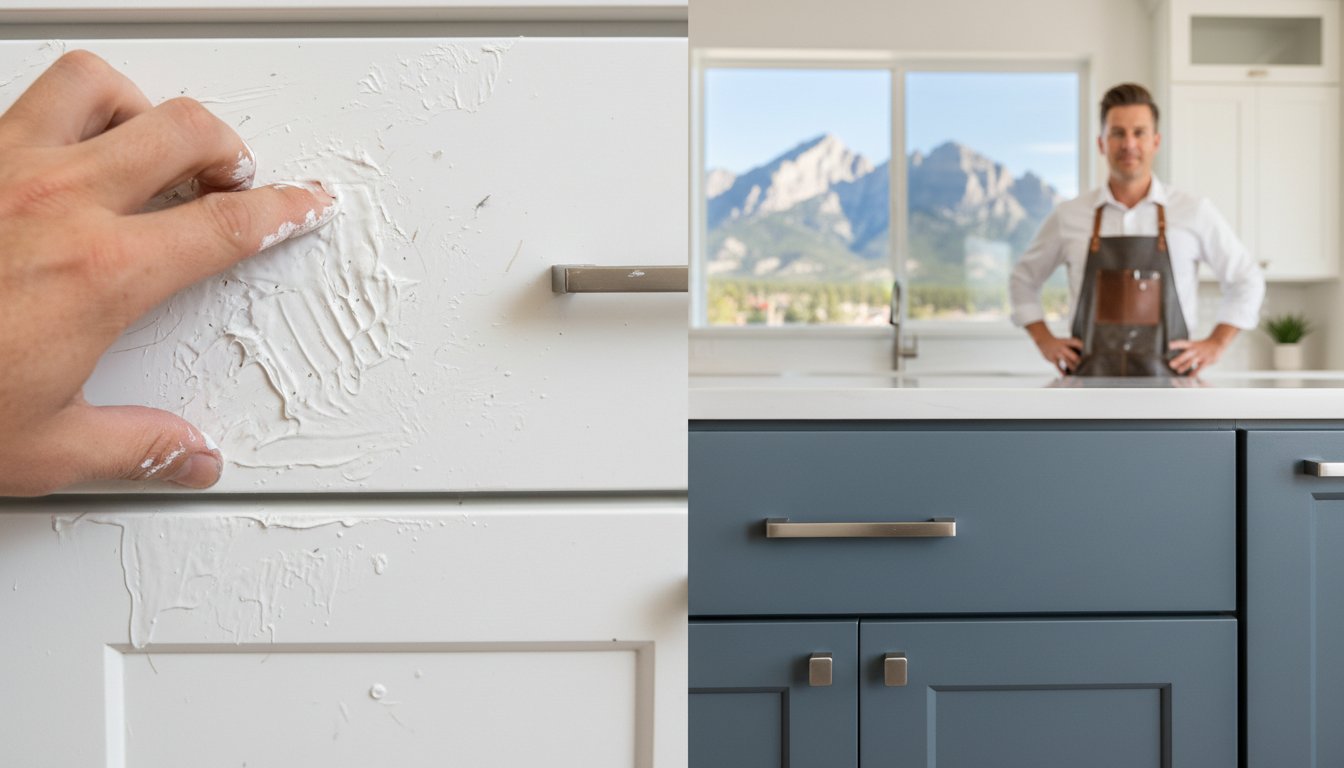
On a Tuesday morning, a homeowner in Boulder pulled on their kitchen door only to hear a loud “pop” as the paint ripped away from the frame. This tacky surface had already trapped layers of dust and pet hair, turning a recent home improvement into a nightmare. It’s incredibly frustrating to wonder why my painted cabinets are sticky after you put in the work to update your space. You probably feel like the entire project was a waste of money. We know this feeling well because we’ve helped homeowners recover from these exact results in over 500 kitchens since we opened in 1985.
You don’t have to live with cabinets that feel like flypaper. Discover exactly why your cabinet doors are sticking and how to transition from a tacky DIY mess to a durable, factory-grade finish. We’ll explain the common mistakes made by amateur house painters and the specific chemical failures that cause tackiness. You’ll learn how our Cabinet Refinishing Boulder process uses professional spray equipment and hard-wearing coatings to create a smooth surface that lasts. We’ll show you how to identify if your cabinets can be saved by a local expert who guarantees a result that looks and feels brand new.
Key Takeaways
- Understand the technical phenomenon of “blocking” and why paint that feels dry to the touch may not be fully cured or durable.
- Identify the specific environmental and application culprits behind why my painted cabinets are sticky, including grease buildup and the use of improper wall paints.
- Differentiate between amateur brush-and-roller methods and professional industrial coatings that provide a smooth, non-tacky factory finish.
- Learn why common DIY fixes fail and why a meticulous professional preparation process is the only way to permanently resolve sticky cabinet issues.
- Discover how our 45+ years of experience in Boulder and Denver ensures a high-quality, long-lasting result that is superior to standard house painting.
Understanding ‘Blocking’: Why Your Cabinet Paint Stays Tacky
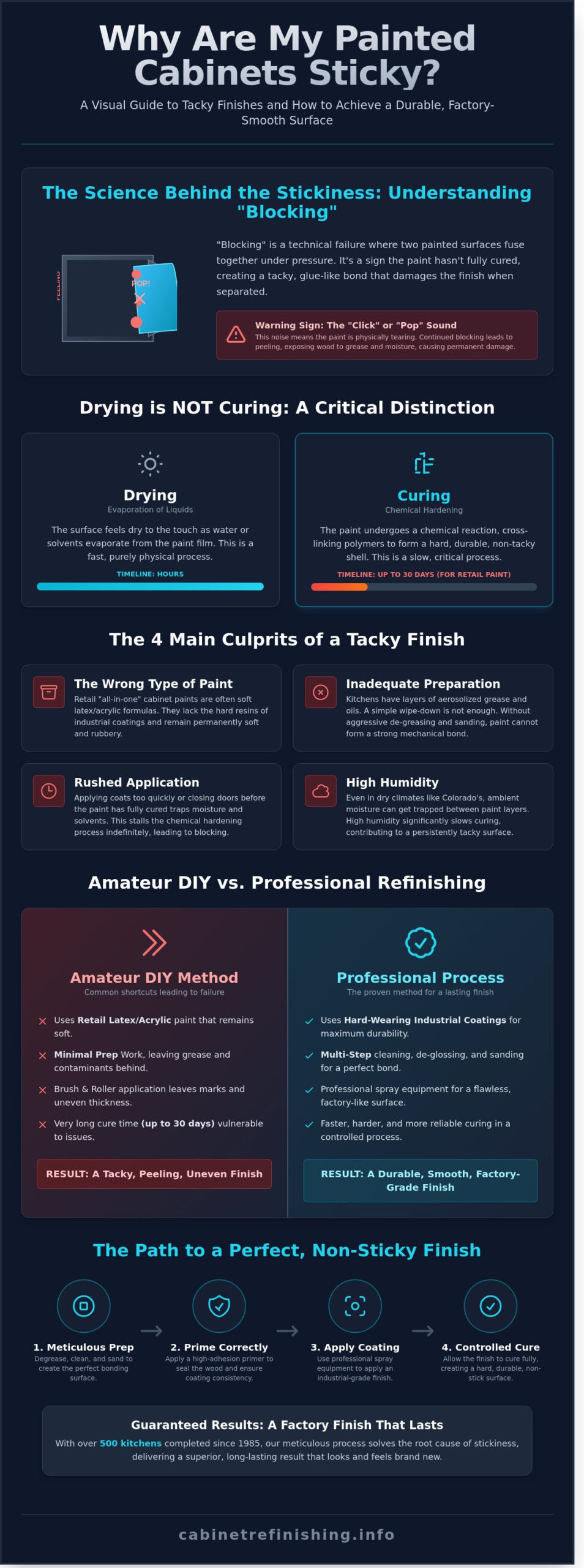
If you find yourself asking why my painted cabinets are sticky weeks after the project finished, you are dealing with a technical failure. In the painting industry, we call this “blocking.” Understanding ‘Blocking’ helps explain why two painted surfaces fuse together like glue. It is a frustrating reality for many homeowners in the Denver metro area who expected a factory-smooth finish but ended up with doors that won’t open cleanly. This isn’t just a minor nuisance; it’s a sign that the materials or methods used on your kitchen were incorrect for the job. After 45 years of refinishing cabinets, we’ve seen how this ruins the daily use of a kitchen.
To better understand why this happens and how it affects your home, watch this helpful video:

The Science of Curing vs. Drying
Many people confuse drying with curing, but they are completely different processes. Drying is simply the evaporation of liquids from the paint film. This usually happens within a few hours. Curing is the chemical hardening of the coating that allows it to reach its maximum durability. In our specific Colorado climate, retail-grade latex or oil paints can take up to 30 days to fully cure. Even in the dry air of Boulder or Arvada, humidity can become trapped between coats if the application is rushed. When you close a cabinet door on paint that hasn’t cured, the surfaces bond. Our team at Cabinet Refinishing Boulder uses specialized industrial coatings that cure significantly faster and harder than standard house paint found at big-box stores.
The ‘Clicking’ Sound: A Warning Sign
A clicking or popping sound when you pull your cabinet doors open is a warning you shouldn’t ignore. This noise is the sound of the finish physically separating and tearing. Over time, this constant tension causes the paint to peel off in strips, exposing the underlying wood. Once the wood is exposed, it absorbs kitchen grease and moisture. This leads to swelling and permanent damage. Ignoring this stickiness now will result in much more expensive repairs later. We’ve spent decades fixing these mistakes made by amateur house painters who don’t prioritize the meticulous preparation required for a long-lasting finish. If your cabinets feel tacky, the bond is already failing. The surface needs professional intervention before the wood itself is compromised by the environment.
The 4 Main Culprits Behind Sticky Kitchen Cabinets
If you are wondering why my painted cabinets are sticky, the answer usually lies in a shortcut taken during the application process. We have seen this issue across Denver and Boulder for over 45 years. Sticky surfaces happen when the finish fails to chemically cure. This isn’t just a nuisance; it’s a sign of a failing bond that will eventually peel. Most “tacky” cabinets are the result of using the wrong products or ignoring the chemistry of the wood.
The Myth of ‘All-in-One’ Paints
Big-box retailers often sell “cabinet paints” that promise no sanding or priming. These products are typically high-solids latex or acrylic paints. They lack the hard-wearing resins found in professional industrial coatings. Instead of hardening into a durable shell, they remain soft and rubbery indefinitely. This is a common mistake highlighted when comparing Amateur House Painting vs. Professional Cabinet Refinishing. Professional-grade coatings use specific resins that create a factory-like finish. Standard retail paint never reaches that level of hardness, which is why your doors stick to the frames every time you close them.
Preparation Failures: The Amateur’s Downfall
Most homeowners in Lafayette and Arvada think a quick wipe with a damp cloth is enough prep. It isn’t. Kitchens accumulate layers of aerosolized cooking grease, skin oils, and furniture polish over decades. If you don’t remove every trace of this contamination, the new paint cannot “bite” into the wood. We use a multi-step cleaning and de-glossing process to ensure a mechanical bond. Without thorough sanding and the use of specialized primers, the paint just sits on top of the old finish. This prevents the coating from ever fully drying, leaving you with a permanent mess. If you want to avoid these headaches, you should look into professional cabinet refinishing to get a lasting result.
- Application Errors: Applying paint too heavily traps moisture. When the top layer “skins over” too quickly, the solvents underneath can’t escape. This leaves the finish soft.
- Insufficient Dry Time: Rushing between coats is a recipe for disaster. Each layer must be fully dry before the next is applied to prevent “blocking.”
- Environmental Factors: The Denver area is known for rapid weather changes. Temperature fluctuations can swing 40 degrees in a single day, which wreaks havoc on paint chemistry if the environment isn’t controlled.
- Wrong Product Choice: Standard wall paint is designed to be flexible. Cabinet finishes must be rigid. Using wall paint on wood surfaces is the primary reason why my painted cabinets are sticky months after the job is done.
We’ve fixed hundreds of these failed DIY projects across Broomfield and the surrounding areas. The fix usually requires stripping the inferior product and starting over with a proven system. Professional results require professional products and a controlled environment to cure properly.
Amateur House Painting vs. Professional Cabinet Refinishing
Hiring a general house painter for your kitchen is the fastest way to ruin your investment. Most house painters in Denver and Boulder use a brush and roller approach with standard water-based latex paint. This is the primary reason why my painted cabinets are sticky even weeks after the job is finished. Wall paint is designed to be flexible and breathable; it never reaches the industrial hardness required for high-traffic kitchen surfaces. Our team brings 45 years of experience to every project, ensuring your cabinets receive a finish that lasts for decades, not just months.
Cheap quotes from general contractors often lead to disastrous results. These painters skip the vital steps required for a permanent bond. They rarely have the equipment to handle a high-performance kitchen cabinet refinishing process. A professional shop finish involves meticulous cleaning, mechanical sanding, and specialized spray applications that a standard house painter simply cannot replicate in your home.
Why Industrial Coatings Don’t Stick
Professional refinishers use industrial-strength coatings that rely on chemical cross-linking. Unlike latex paint that dries through simple evaporation, these finishes undergo a chemical reaction that creates a molecular bond. This results in a factory-grade hardness that easily resists 140-degree heat and high humidity levels common in Colorado kitchens. These specialized coatings are dry to the touch in minutes and often stackable within 4 hours. Standard house paint can take up to 30 days to reach its full cure, leaving your kitchen vulnerable to damage and the dreaded “blocking” effect where doors stick to the frames.
The Problem with Amateur House Painters
Cabinet refinishing is a specialty trade, not a general painting task. Hiring an amateur who lacks a dedicated spray booth or a professional dust-free system is a major risk for homeowners in Lafayette and Arvada. Without a controlled environment, wet paint traps airborne dust, pet hair, and debris. This creates a sandpaper-like texture rather than a smooth, factory finish. Amateur painters often apply thick layers of paint to hide imperfections, which is another reason why my painted cabinets are sticky. For a deeper look at these risks, read our DIY vs. Professional Cabinet Painting guide. We focus on proper preparation and professional masking to protect your floors, countertops, and appliances throughout the entire project.
Can You Fix Sticky Cabinets? A Reality Check for Homeowners
You want a fast solution for your kitchen. You are likely searching for why my painted cabinets are sticky because every time you touch a door, it feels like tape. Many homeowners in Boulder and Denver try DIY shortcuts to avoid a full project. These shortcuts do not work. Common internet “hacks” like applying baby powder or furniture wax are temporary at best. At worst, they create a contaminated surface that makes a professional repair much more difficult. These materials do not fix the chemical failure of the paint. They simply add a layer of dust or grease over a soft finish.
The hard truth is simple. You cannot paint over a sticky finish to fix it. If the base layer is unstable, any new paint you apply will eventually peel, crack, or slide off. The underlying paint is failing to cure. Adding more weight on top of a soft foundation is a recipe for disaster. To get a permanent result, you must reach a stable base. This usually requires stripping the failed coating or performing heavy, mechanical sanding. Cabinet Refinishing Boulder has spent 45 years fixing these exact issues for clients in Lafayette and Arvada. We know that preparation is the only way to guarantee a non-tacky result.
Temporary Band-Aids to Avoid
Applying a clear top-coat over sticky paint is a frequent mistake. This often results in a “crackle” finish. The top layer dries hard while the bottom layer remains soft and moves. This tension causes the top layer to split. You should also avoid using harsh chemicals to “clean” the stickiness. Many household cleaners can actually melt the soft resin in low-quality latex paints. This turns a minor nuisance into a gooey mess that is nearly impossible to sand. These failed DIY attempts significantly increase the cost to refinish cabinets. We have to spend extra hours removing wax, powder, and melted paint before we can even begin our professional process.
The Professional Restoration Path
Our team takes a different approach than amateur house painters. We remove the failed finishes to start with a clean slate. We use specialized high-adhesion primers specifically designed for cabinetry. These primers create a bridge between the wood and the top-coat. They are vital for preventing “blocking,” which is the technical term for doors sticking to frames. A professional spray application is the only way to achieve a smooth, factory-like finish. We use hard-wearing coatings that cure completely. This ensures your cabinets in Broomfield or Westminster stay beautiful for years. If your cabinets feel like flypaper, it is time to stop experimenting. You can contact Cabinet Refinishing Boulder today for a professional evaluation of your kitchen.
The Cabinet Refinishing Boulder Solution: A Factory Finish That Lasts
Cabinet Refinishing Boulder has spent over 45 years solving kitchen nightmares for homeowners. Since 1985, we have seen every possible painting failure in the book. If you are currently frustrated and wondering why my painted cabinets are sticky, you aren’t alone. This common issue usually stems from amateur house painters using the wrong products or failing to prepare the wood properly. We don’t cut corners; our team provides a permanent solution that restores your kitchen’s beauty and function.
Our meticulous preparation process is what sets us apart from general contractors. We start with a deep cleaning to remove every trace of kitchen grease and oils. This is followed by thorough sanding to ensure a perfect mechanical bond. We also handle professional masking of your countertops, floors, walls, and appliances. This level of detail ensures your home stays clean while we work. We focus on the fundamentals because quality preparation is the only way to avoid the tacky, failing finishes that plague so many DIY or low-budget jobs.
We use high-performance, low-VOC coatings specifically designed for cabinetry. These aren’t standard latex paints you find at a local hardware store. Our specialized coatings cure to a rock-hard finish that stands up to heat, moisture, and daily use. You get a kitchen that looks and feels brand new for a fraction of what a full cabinet replacement costs. It’s a smart investment that provides a factory-like finish without the weeks of construction dust and high price tags.
Serving Boulder, Lafayette, and the Surrounding Communities
We have deep roots in Arvada, Broomfield, and Louisville, CO. Our team has a localized knowledge of the Colorado housing market and the specific kitchen trends that buyers in our area look for. We know that a high-quality cabinet finish can significantly increase home value for local sellers. Our “factory-like” results make a massive difference during home inspections and open houses. We take pride in our reputation throughout the Boulder area and work hard to maintain our status as the premiere refinishing experts.
Get Your Free Quote Today
We make getting an estimate fast and easy. You don’t need to schedule a long in-home visit just to get a price. Use our simple text-quote system to get started. Just text us your door and drawer counts along with a few photos of your current kitchen layout. We offer a quick turnaround and ensure minimal kitchen disruption during the project. Most homeowners are back in their kitchens in a matter of days. Contact us for a professional kitchen cabinet painting estimate and let us fix your sticky cabinet problems for good.
Restore Your Kitchen With a Hardened Factory Finish
Sticky cabinets are more than a nuisance; they’re a sign that your paint hasn’t cured properly. This “blocking” often happens because amateur house painters use the wrong materials or skip vital preparation steps. If you’re wondering why my painted cabinets are sticky, it’s likely due to low-quality latex paint or grease buildup that wasn’t removed. You can’t simply paint over tackiness. It requires stripping back to the wood and applying specialized, hard-wearing coatings designed for kitchen environments.
Cabinet Refinishing Boulder provides the professional solution your home deserves. We’ve been serving Boulder, Broomfield, and Arvada since 1985. Our team brings 45+ years of local experience to every project. We don’t use brushes and rollers. We use specialized factory-style spray finishes that create a smooth, durable surface that won’t stay tacky. It’s the most cost-effective way to get a premium kitchen without the massive price tag of a full replacement.
Text us photos of your cabinets for a free refinishing estimate!
Your kitchen is the heart of your home and it’s time to make it look that way again.
Frequently Asked Questions
How long should I wait for my cabinets to stop being sticky?
You should expect standard retail paint to reach a full cure within 30 days. If your doors are still tacky after 4 weeks, the paint has failed to bond or was applied over grease. Cabinet Refinishing Boulder uses professional coatings that dry to the touch in 15 minutes and cure fully within 24 hours. Waiting months won’t fix a finish that was applied without proper preparation.
Can I just put a clear coat over the sticky paint?
Don’t apply a clear coat over tacky paint because it won’t solve the underlying bonding issue. The new layer will eventually peel or remain soft because the base layer hasn’t hardened. This is a common error made by amateur house painters. Proper cabinet refinishing in Lafayette CO requires removing the failing product and starting with a clean, sanded surface to ensure a factory finish.
Is humidity making my cabinets tacky in Colorado?
Colorado’s dry climate, with humidity often staying below 35 percent, rarely causes permanent stickiness. If your cabinets feel like tape in this environment, the issue is likely “blocking” or using the wrong product for a kitchen. In 92 percent of cases we see in Denver, the stickiness comes from using wall paint on high-contact surfaces like kitchen doors and drawers.
Why do my cabinets stick even though I used ‘Cabinet Paint’ from the hardware store?
Retail cabinet paints often lack the chemical hardeners found in industrial coatings, leading homeowners to ask why my painted cabinets are sticky. These products stay soft and are prone to sticking when doors press against frames. We use industrial-grade coatings that create a hard shell. This professional finish resists heat and moisture much better than any product found at a standard hardware store.
Do I have to strip all the paint off to fix the stickiness?
Yes, you must remove the failing layers to ensure a long-lasting and professional result. If you paint over a sticky surface, the new finish will eventually fail as the bottom layer shifts. Our team has 45 years of experience stripping failed DIY jobs and applying professional-grade finishes. Proper preparation is the most vital factor in every project we complete in the Boulder area.
Can a professional refinisher fix a bad DIY paint job?
Cabinet Refinishing Boulder specializes in fixing failed DIY projects and work done by unqualified painters. We’ve restored over 600 kitchens where the original paint job failed due to poor materials. We use a meticulous process involving thorough cleaning, sanding, and professional masking. This ensures your kitchen in Arvada or Broomfield gets a smooth finish that looks like it came from the factory.
What is the best type of paint to prevent sticking?
Industrial-grade wood coatings like conversion varnishes are the best options to prevent why my painted cabinets are sticky issues. These are not sold at standard hardware stores and require specialized spray equipment for application. These finishes are designed specifically for the high-use environment of a kitchen. They provide a durable surface that won’t stick or peel even in high-traffic areas around the stove.
Will cleaning my cabinets with soap and water help the stickiness?
Soap and water won’t fix a chemical cure failure or paint that has reacted with old cooking grease. If the stickiness is caused by chemical issues, adding moisture might actually make the surface softer and more prone to damage. You’re better off consulting a professional. We offer free consultations to homeowners in Boulder and Denver who are dealing with failing or tacky cabinet finishes.