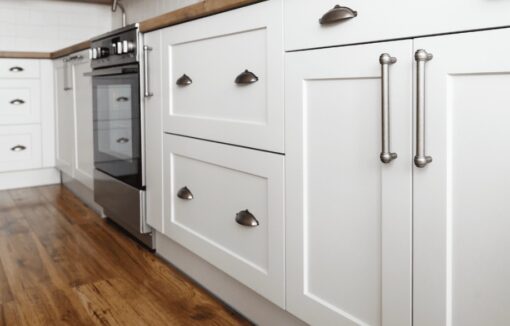
That dated kitchen staring back at you every morning doesn’t have to mean a full, expensive tear-out. But hiring a general house painter often leads to a peeling, chipping disaster that looks worse than when you started. The most critical question we hear from homeowners is when to refinish kitchen cabinets and when you’re just throwing good money after bad. A professional refinishing job can deliver a stunning, factory-like finish for a fraction of the cost of a remodel, but only if your cabinets are the right candidates.
Cabinet Painting Service Areas in Boulder County, Lafayette CO. & Surrounding Cities, Cabinet Refinishing in All of Northern CO.
Cabinet Painting in Boulder County & Northern Colorado
Brighton, CO, and Broomfield, CO.
Including Superior, CO, Louisville, CO, Niwot CO,
Lafayette, CO, Erie, CO, Firestone, CO,
Frederick, CO, Longmont, CO, Loveland, CO,
We also service projects throughout the entire state of Colorado.
This guide is a contractor’s straightforward answer. We’ll cut through the confusion between refinishing, refacing, and replacing. You’ll get a simple checklist to inspect your own cabinets for the tell-tale signs of good ‘bones’-and the red flags that signal it’s time to replace them. Stop wondering if your cabinets are good enough. By the end of this article, you’ll have the confidence to make a smart, cost-effective decision for your kitchen update.
Key Takeaways
-
Before looking at the finish, assess your cabinet boxes and doors for structural integrity-this is the most critical factor in your decision.
-
Knowing when to refinish kitchen cabinets often comes down to cosmetic issues like an outdated color, minor scratches, or a worn-out finish on solid cabinets.
-
Major problems like water damage, warped wood, or soft particleboard are serious red flags that refinishing cannot fix and will result in wasted money.
-
Learn the key differences in cost, time, and disruption between refinishing, refacing, and a full replacement to make the right choice for your project.
Table of Contents
The First Question: Are Your Cabinet ‘Bones’ Good?
Before you worry about faded paint or an outdated wood stain, the first step is to look deeper. A high-quality, factory-finish paint job is only as good as the surface it’s applied to. As professionals, the very first thing we assess is the structural integrity of your cabinets. Deciding when to refinish kitchen cabinets versus replacing them always starts with this critical evaluation. A great finish cannot fix warped boxes, sagging shelves, or a dysfunctional kitchen layout.
To see how solid cabinets can be completely transformed without stripping, this video offers a great overview:

Assessing Structural Integrity
Your cabinet boxes, doors, and drawers must be solid. Open and close everything. Do the doors hang straight? Do drawers slide smoothly without catching? Look for signs of water damage, especially under the sink. The fundamentals of Kitchen cabinet construction show that certain materials hold up far better over time. We check for:
-
Solid Construction: The cabinet boxes should be square and free of warping or sagging.
-
Material Quality: Solid wood and high-quality plywood are excellent candidates for refinishing. We look for delamination or swelling on cabinets made from particle board or MDF, which can be a sign that replacement is necessary.
-
Proper Function: Doors and drawers must operate correctly. Misaligned hardware can often be fixed, but broken drawer boxes cannot.
Evaluating Your Kitchen Layout
This is a question of function, not just aesthetics. Refinishing will dramatically update the look of your kitchen, but it will not change its footprint. Ask yourself: does this layout work for my family? If you constantly find yourself wishing for more counter space, a better workflow between the sink and stove, or a different island configuration, refinishing might not be the right answer. If the layout is fundamentally flawed, a full remodel and cabinet replacement is the better long-term investment. Knowing when to refinish kitchen cabinets also means knowing when a bigger change is truly needed.
Green Lights: 5 Signs You Should Definitely Refinish Your Cabinets
If your cabinet boxes are solid and the layout works for you, there’s no need for a costly replacement. Understanding when to refinish kitchen cabinets often comes down to cosmetic issues that a professional can easily solve. These signs are green lights that a refinishing project is your best investment. It’s a high-impact, cost-effective way to get a new kitchen look without the mess and expense of a full tear-out. If you see these problems, your cabinets are perfect candidates for a factory-quality finish.
Look for these tell-tale signs that point to refinishing, not replacing.
Outdated Color or Wood Finish
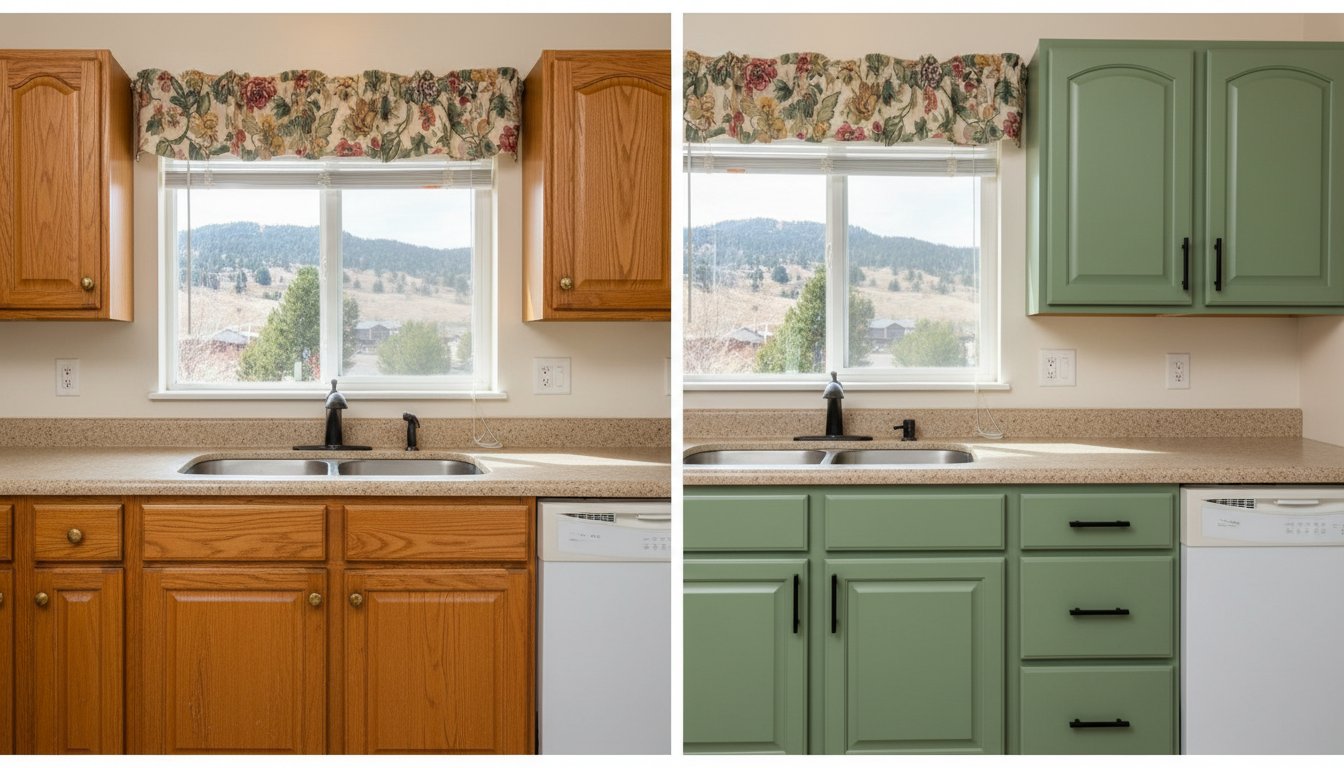
This is the most common reason we get calls. Your cabinets work perfectly fine, but their look is stuck in the past. That honey-colored golden oak from the 90s or the dark cherry finish that absorbs all the light in your kitchen can be completely transformed. A professional refinishing job allows you to update your space with a modern, durable paint color-like a clean white, a sophisticated gray, or a bold navy. Your kitchen style should match your own, and refinishing makes that happen.
Minor Scratches, Dents, and Dings
Years of daily use will leave their mark. Small nicks on drawer fronts, scratches near the handles, and dings on corner doors are all part of normal wear and tear. These surface-level imperfections are exactly what our process is designed to fix. Proper preparation is vital. We fill, sand, and prime every surface to create a flawless foundation before applying our durable topcoats. An amateur house painter will just paint over these flaws; we make them disappear completely.
Fading, Discoloration, or Sun Damage
Have you noticed that the cabinets hit by the afternoon sun are a different color than the others? This is a classic sign of UV damage. Over time, sunlight can bleach wood stains and fade paint. Discoloration also comes from years of cooking grease and grime building up, often leaving a sticky, yellowish film that’s impossible to clean. Refinishing solves this by creating a fresh, perfectly uniform color across every single door and drawer, protected by a durable, lasting finish.

Red Flags: 4 Signs You Need to Replace, Not Refinish
Cabinet refinishing is a fantastic way to update your kitchen, but it is not a solution for every problem. Some issues go deeper than the surface finish, and simply painting over them is a waste of money and will not last. A trustworthy contractor will be honest about your cabinet’s condition to help you avoid a costly mistake. Understanding when to refinish kitchen cabinets and when to replace them is the key to a successful project.
If you see any of these four red flags, it’s time to consider a full replacement instead of a refinishing job.
Significant Water Damage
Water is the number one enemy of kitchen cabinets, especially those made from particle board or MDF. Look for swollen wood, warped doors, or soft spots, particularly under the sink. Dark stains that have penetrated deep into the wood grain cannot be sanded out or covered. Water damage instantly compromises the structural integrity of particle board, causing it to crumble. No amount of paint can fix this fundamental failure.
Widespread Peeling Thermofoil or Laminate
Thermofoil is a thin layer of vinyl that is heat-fused to an MDF core. While durable at first, this vinyl can bubble, peel, and delaminate over time, especially near heat sources like your oven or dishwasher. Once it begins to peel, it is extremely difficult to create a smooth, lasting surface for paint. The proper preparation involves stripping all the vinyl, which is a labor-intensive and costly process that often makes replacement a more practical option.
Major Structural Failures
A quality finish needs a solid foundation. If your cabinets have reached the end of their functional life, refinishing them is not a sound investment. These are signs that the core structure is failing:
-
Cabinet boxes that are broken, sagging, or pulling away from the wall.
-
Face frames that are split or cracked.
-
Doors so warped they no longer close properly.
-
Drawer boxes that are falling apart and cannot be easily repaired.
You Hate Your Kitchen’s Layout
Finally, be honest about your kitchen’s function. Refinishing can make your cabinets look new, but it can’t fix a poor workflow, add storage, or give you more counter space. If you are constantly frustrated with the layout, don’t invest in a cosmetic update for a kitchen you plan to change. It is far wiser to put that budget towards a full kitchen remodel that will serve you better for years to come.
If a full remodel seems like the right path, it’s helpful to see what’s possible. The work of specialists like D&S Kitchen LLC, though based in Florida, can provide great inspiration for a complete kitchen transformation.
Not sure if your cabinets are a good candidate for refinishing? We provide honest, expert advice. Text us pictures for a quick assessment.
Refinish vs. Reface vs. Replace: Understanding Your Options
Once you see the signs of wear, the next step is choosing the right solution. Understanding the difference between refinishing, refacing, and a full replacement is vital for making an informed financial decision. Each option varies significantly in cost, timeline, and the level of disruption to your daily life. Knowing these differences helps you determine when to refinish kitchen cabinets versus when a more drastic approach is truly necessary.
For homeowners with structurally sound cabinets, refinishing almost always offers the best value. It provides a dramatic transformation without the waste and expense of a tear-out.
Cabinet Refinishing (Painting)
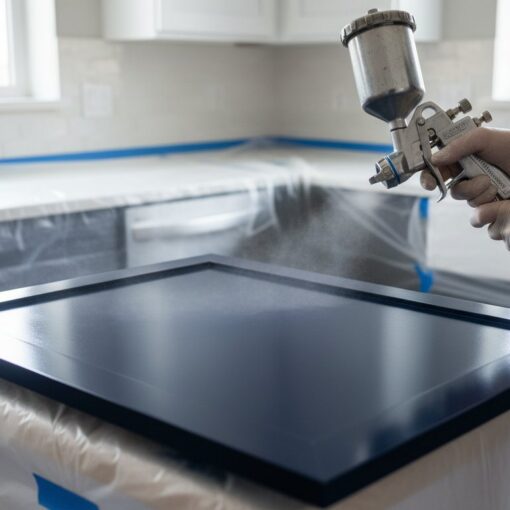
Refinishing is the most cost-effective and fastest way to get a completely new look. This process keeps all your existing cabinet boxes, doors, and drawer fronts. Our professional method focuses on meticulous preparation to deliver a durable, factory-perfect finish that amateur house painters cannot replicate.
-
Process: We thoroughly clean, sand, prime, and apply multiple coats of premium, industrial-grade paint with professional sprayers.
-
Best For: A cosmetic update when your cabinet layout works and the boxes are in good condition.
-
Outcome: A smooth, modern, and durable finish in any color you choose.
Cabinet Refacing
Refacing is a middle-ground option. Your cabinet boxes remain, but we replace all the doors and drawer fronts with new ones. A matching wood or laminate veneer is then applied to the visible exteriors of the boxes. This is a good choice if you want a completely different door style (like Shaker or slab) but want to avoid the cost of a full replacement. It is significantly more expensive and takes longer than refinishing.
Full Cabinet Replacement
This is a complete demolition and installation of entirely new cabinets. A full replacement is the most expensive, disruptive, and time-consuming project of the three. It involves tearing out all old cabinet boxes and requires new plumbing, electrical, and countertop work. Replacement is only necessary when you are changing the entire kitchen layout or if your existing cabinet boxes are structurally failing, warped, or have severe water damage. For most kitchens, this is overkill.
Before you commit to the cost and chaos of a full replacement, see how our specialized refinishing process provides a stunning, like-new look for a fraction of the price. View our gallery.
Making the Right Choice for Your Kitchen Cabinets
Deciding when to refinish kitchen cabinets ultimately comes down to one critical factor: the condition of your cabinet boxes. If the "bones" are good, you can completely transform your kitchen for a fraction of the cost of a full replacement. Cosmetic issues like a dated color or minor wear are perfect candidates for our process, while major structural damage is a red flag that points toward replacement.
Don’t trust this important job to an amateur house painter. A true, factory-like finish requires specialized skill and preparation. With 38+ years of experience serving Boulder and surrounding communities, we specialize in the durable, high-quality finishes your kitchen deserves. We know what it takes to do the job right and deliver results that last.
Ready to see the difference professional quality makes? Get a Fast, Free Quote for Your Boulder Kitchen Cabinet Refinishing Project.
A beautiful, updated kitchen is closer and more affordable than you think.
Frequently Asked Questions About Cabinet Refinishing
Can you refinish any type of kitchen cabinet material?
Solid wood, wood veneers, and even MDF are excellent candidates for professional refinishing. These materials can be properly prepped to accept a durable, factory-like finish. However, plastic laminate and thermofoil cabinets are generally not suitable for refinishing. The slick surface prevents proper adhesion, which means the new finish will inevitably peel and chip. A true professional will tell you what works and what doesn’t, unlike an amateur house painter who might promise the impossible.
Is it worth refinishing old but high-quality solid wood cabinets?
Absolutely. It is always worth refinishing high-quality solid wood cabinets. Older cabinets are often built with superior craftsmanship and materials compared to many modern, mass-produced options. By refinishing, you preserve that durable construction while getting a completely updated, modern look for your kitchen. Tearing out structurally sound wood cabinets is a costly mistake. A professional finish will restore their beauty and protect your investment for years to come.
How long does a professional cabinet refinishing job last?
A high-quality, professional cabinet refinishing job will last for 8 to 15 years, and often longer. The durability of the finish is not just in the paint-it’s in the meticulous preparation. Proper degreasing, sanding, and priming are vital factors that ensure the finish adheres correctly and withstands daily use. This is the critical difference between a lasting result from a specialist and a job from a general painter that starts failing in a year or two.
Will refinishing my cabinets increase my home’s value?
Yes, refinishing your kitchen cabinets provides an excellent return on investment and can significantly increase your home’s value. The kitchen is a focal point for potential buyers. A bright, updated kitchen with professionally finished cabinets makes a powerful first impression and can make the entire home feel more modern and well-maintained. It’s one of the most impactful upgrades you can make for a fraction of the cost of a full kitchen remodel.
My cabinet finish is sticky and gummy. Can that be fixed by refinishing?
Yes, a sticky or gummy surface is a common sign of a failing finish and a key indicator of when to refinish kitchen cabinets. This problem is caused by the original lacquer breaking down from years of exposure to oils, cleaning products, and sunlight. Our professional process completely resolves this. We thoroughly strip and sand away the old, degraded coating, creating a clean slate before applying a new, durable, and non-sticky factory finish.
Do I need to refinish the inside of my cabinets too?
Typically, no. The standard professional practice is to refinish all visible surfaces. This includes the fronts and backs of all doors, the drawer fronts, and the exterior face frames of the cabinet boxes. The interiors of the cabinets are generally left as-is, as they are not visible when the doors are closed and don’t suffer the same wear. This approach provides a complete visual update while keeping the project cost-effective for the homeowner.