
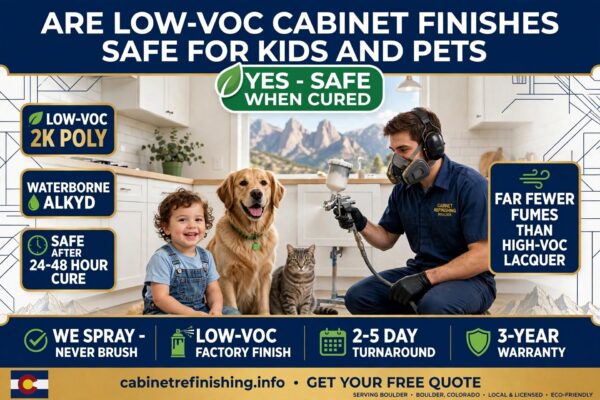
Low-VOC cabinet finishes are safe for kids and pets when cured, with 2K Poly and waterborne alkyd releasing far fewer fumes than high-VOC lacquer, most in the first 24-48 hours. Yes. A cabinet refinishing project finished with a low-VOC 2K poly or waterborne alkyd system is safe for kids and pets when the right products, containment, and cure times are used. The practical difference comes down to chemistry: low-VOC waterborne finishes release far fewer volatile compounds than traditional high-VOC lacquer, and most of that release happens within the first 24 to 48 hours. Homeowners in Boulder County can plan around a clear, realistic timeline and stay in their homes during the work.
Table of Contents
- What does “low-VOC” actually mean for cabinet finishes?
- Is 2K poly safer than high-VOC lacquer for a family kitchen?
- How long until the kitchen is safe for kids and pets again?
- Which low-VOC products do we actually spray on Boulder County cabinets?
- Do I need to move out during cabinet refinishing?
- What should I ask a refinisher before they spray my kitchen?
- Are there zero-VOC options worth considering for cabinets?
- Key Takeaways
- References
What does “low-VOC” actually mean for cabinet finishes?
Low-VOC means the product contains volatile organic compounds below a set regulatory threshold. The EPA defines low-VOC latex paint as containing less than 250 grams per liter, and low-VOC oil-based paint as less than 380 grams per liter, according to Cabinets Painting. The Green Seal certification standard is stricter, requiring latex paints to stay under 50 grams per liter.
Typical ranges tell a clearer story. Low-VOC latex paints carry 10 to 50 grams per liter of VOCs. Waterborne alkyd cabinet paints such as Benjamin Moore Advance and Sherwin-Williams Emerald Urethane both deliver VOCs under 50 grams per liter, according to Cabinets Refinishing. Traditional oil-based paints often exceed 150 grams per liter in many formulas.

Indoor air quality is the reason this matters. The EPA documents indoor VOC concentrations at two to five times higher than outdoor levels, and those levels can spike to 1,000 times normal background during active painting or stripping, reports Cabinets Painting. Common VOCs include benzene, formaldehyde, xylene, toluene, and ethylene glycol.
Low-VOC is not the same as zero-VOC. Tinted colorways can add VOCs on top of the base paint, so a clear base may test differently than a deep custom color. Homeowners should ask about the final mixed product, not just the can on the shelf.
Low-VOC Cabinet Finishes: What Makes Them Safe?
Yes, in most family kitchens a sprayed 2K poly system is the safer choice compared with traditional solvent lacquer. A 2K poly is a two-component waterborne finish that uses a chemical hardener. Traditional lacquer relies on strong solvents that flash off quickly, which is why lacquer dries fast but also offgasses heavily during application and the first day after.
The durability angle matters for households with kids and pets. A factory-style sprayed 2K poly finish holds up to daily wiping, kid traffic, and the occasional pet claw far better than a standard wall paint. The finish cures into a hard, cleanable surface that behaves more like a factory cabinet door than a painted wall.
The honest caveat is that 2K products still require professional handling. The safety benefit is real, but the application requires respirators, ventilation, and proper containment. Safety lives in the process, not only in the product chemistry.
How long until the kitchen is safe for kids and pets again?
Water-based low-VOC lacquers dissipate the majority of volatile compounds within 24 to 48 hours, according to Cabinets Painting. Cabinet doors are typically rehung after 48 to 72 hours, while full chemical cure takes 14 to 30 days, reports Cabinets Refinishing.
The practical rule for Boulder County homeowners is simple. Keep pets and small children out of the contained work zone during spray days. Once the doors are rehung and the work area is cleaned, normal use can resume. For low-VOC cabinet finishes, cure time is what matters – 24-48 hours before kids and pets use the kitchen.
Dry is not the same as cured. The surface may feel dry within hours, but hardness develops over several weeks. Treat freshly refinished cabinets gently at first, especially around edges and door corners.
Which low-VOC products do we actually spray on Boulder County cabinets?
We refinish kitchen cabinets to a sprayed factory finish using low-VOC waterborne systems suited to Colorado’s altitude and dry air. The products are chosen for how they atomize through HVLP sprayers with 1.3 to 1.5 mm tips, which produce the smooth factory look homeowners expect, according to Cabinets Refinishing.
For older cabinets, we use waterborne bonding primers such as Zinsser Bulls Eye 1-2-3 and STIX Waterborne Bonding Primer. When stains need blocking, a shellac-based primer like Zinsser BIN does the job. Prep quality determines 90 percent of cabinet finish durability, so surface preparation and primer choice matter as much as the topcoat.
Cabinet, painting, and refinishing in all of Boulder county serves homeowners in Boulder, Longmont, Lafayette, Louisville, Superior, Erie, and Niwot. The same low-VOC sprayed finish approach applies across every service area.
Do I need to move out during cabinet refinishing?
No, most homeowners do not need to move out. Most Boulder County kitchens take 4 to 5 days with low-odor products and clean containment, so staying home is realistic. The key is proper containment during spray days.
Containment works through plastic sheeting, sealed doorways, and negative air to keep overspray and odor from drifting into living spaces. The kitchen itself becomes a contained work zone, but the rest of the home stays usable.
Waterborne systems make staying home far more practical than solvent lacquer would. Low-odor products reduce the disruption, and the 24 to 48 hour dissipation window means the air clears quickly after spraying stops.
What should I ask a refinisher before they spray my kitchen?
Ask for the product data sheet and the actual VOC number, not just a verbal promise that the finish is low-VOC. The data sheet shows the tested grams per liter for the exact product being sprayed.
Ask about containment, ventilation, and whether pets should be relocated on spray days. A clear answer tells you whether the crew treats the home as a lived-in space or just a job site.
Ask about cure time and when doors go back on. Doors typically go back after 48 to 72 hours, but full cure takes 14 to 30 days, according to Cabinets Refinishing.
Ask whether colorants affect VOC levels in tinted colors. The base may test low, but added colorant can shift the final number, so the mixed product is what matters.
Are there zero-VOC options worth considering for cabinets?
Yes, but the trade-off is durability. ECOS Paint is a water-based, zero-VOC paint certified as non-toxic and made in the USA, according to The Good Trade. ECOS Paint offers coverage of 560 square feet per gallon with pricing starting around $89 per gallon.
AFM Safecoat Ecolacq is formulated specifically for cabinetry and millwork, which makes it a closer match for cabinet surfaces than general wall paint, reports Cabinets Painting.
Zero-VOC wall paints are not always the best durability match for cabinet surfaces. That is why product selection should match the surface. For planning purposes, Benjamin Moore Advance and Sherwin-Williams Emerald Urethane run 350 to 400 square feet per gallon at $64 to $115 per gallon, according to Cabinets Refinishing.
Key Takeaways
- The EPA defines low-VOC latex paint as under 250 g/L and low-VOC oil-based as under 380 g/L.
- Green Seal certification requires latex paints to stay under 50 grams per liter of VOCs.
- Indoor VOC levels run two to five times higher than outdoor levels and can spike up to 1,000 times during active painting.
- Water-based low-VOC lacquers dissipate most volatile compounds within 24 to 48 hours.
- Cabinet doors are typically rehung after 48 to 72 hours, with full chemical cure taking 14 to 30 days.
- Benjamin Moore Advance and Sherwin-Williams Emerald Urethane both deliver VOCs under 50 g/L.
- Prep quality determines 90 percent of cabinet finish durability, so containment and surface prep matter as much as the product. When you compare low-VOC cabinet finishes, ask if they spray 2K Poly – spraying is the factory finish.
References
- Eco-Friendly Cabinet Painting Using Low VOC Lacquer Finishes — Cabinets Painting
- The 9 Best Non-Toxic Paints With Low VOCs (2026) — The Good Trade, updated August 6, 2026
- Best Low-VOC Cabinet Paint Options for Your Kitchen — Cabinets Refinishing


