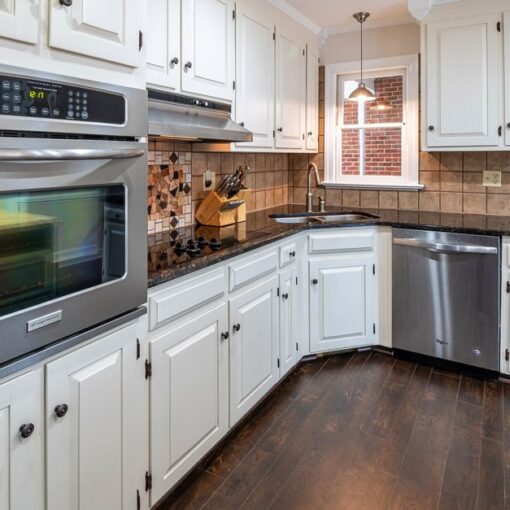

If you live in Lafayette, Colorado, and you have been staring at your tired kitchen cabinets wondering whether to replace or refinish them, you are not alone. Homeowners across Boulder County face this decision every year, and the answer almost always comes down to one question: Can a local painter actually deliver a finish that looks like it came from the factory? The short answer is yes, but only if you hire a specialist who understands the materials, the process, and the specific demands of our Front Range climate. This guide will walk you through exactly what cabinet painting Lafayette CO factory finish means in practice, what it should cost, how the process works, and how to separate true craftsmen from general house painters who will leave you with peeling doors and regret.
My Review of Graco FFLP Tips for Spraying Cabinets
Table of Contents
- Why "Factory Finish" Matters for Your Lafayette Home
- The Cost of Cabinet Painting in Lafayette, CO (2026 Pricing Guide)
- Our Proven Process for a Flawless Factory Finish
- Choosing the Right Coating: Renner vs. Envirolak vs. Sherwin-Williams
- DIY vs. Professional: The Real Cost of a Mistake
- What Lafayette Homeowners Are Asking (FAQ)
- Why Lafayette Homeowners Trust Us for a Factory Finish
- Get Your Free, No-Obligation Quote for Lafayette Cabinet Painting
Why "Factory Finish" Matters for Your Lafayette Home
Looking to save thousands vs. replacing your cabinets?
Our professional spray-applied lacquer finish
lasts far longer than standard brush-on paint. We serve homeowners throughout
Boulder,
Lafayette, and
Broomfield with a 2-year warranty.
A factory finish is not just marketing language. It describes a specific result: a glass-smooth, uniform coating with no brush strokes, no roller stipple, and no orange peel texture. In a factory, cabinets are sprayed with catalyzed coatings inside a dust-free booth and then cured under controlled conditions. The finish is hard, even, and built to withstand years of daily use. When a professional refinisher promises a factory finish in your Lafayette home, they are committing to replicating those conditions as closely as possible on site.

This matters more in Colorado than in many other parts of the country. Our dry air, intense sun, and wide temperature swings put real stress on painted surfaces. Cabinets expand and contract with the seasons. A coating that is too brittle will crack. One that is too soft will scuff and peel. A true factory-style finish uses chemically cured coatings that remain stable through these shifts, bonding to the wood or existing finish at a molecular level rather than simply sitting on top like wall paint.
Standard house painters rarely have the equipment or training to pull this off. They work with brushes and rollers, and they use off-the-shelf paints designed for walls and trim. The result might look acceptable from across the room, but up close you will see the texture, and within a year or two you will see the wear. This guide exists to help you avoid that outcome and find a Lafayette specialist who can give your cabinets the finish they deserve.
The Cost of Cabinet Painting in Lafayette, CO (2026 Pricing Guide)
One of the most frustrating things for Lafayette homeowners researching this project is the lack of transparent pricing online. The search results are full of vague promises and a single outdated figure from a California-based source that has nothing to do with our local market. Let us fix that right now with realistic 2026 pricing for cabinet painting in Lafayette and the surrounding Boulder County area.
For a professionally sprayed factory finish, here is what you should expect to invest based on kitchen size.
A small kitchen with 10 to 15 door and drawer fronts typically runs between $1,800 and $2,800. A medium kitchen with 16 to 25 doors falls in the $2,800 to $4,500 range. A large kitchen with more than 25 doors, custom trim, or complex features like large islands and pantry banks can reach $4,500 to $7,000 or more. These figures include all prep work, priming, spraying, and reinstallation with your existing hardware.
Several variables move the needle on price. The number of doors and drawer fronts is the biggest factor, but the condition of your existing finish matters too. Cabinets coated in years of cooking grease require more aggressive degreasing and sanding. Cabinets with heavy grain or intricate profiles take longer to prep. The coating brand also affects cost. High-end products like Renner or Envirolak cost more per gallon than standard commercial finishes, but they deliver a noticeably smoother and more durable result.
To put these numbers in perspective, full cabinet replacement in a Lafayette kitchen typically starts around $15,000 and can easily exceed $30,000 for custom work. Professional painting saves you 50 to 70 percent while giving you a finish that is nearly indistinguishable from new factory cabinets. That is a meaningful difference, especially when you consider that the timeline for painting is measured in days while replacement can drag on for weeks.
Our Proven Process for a Flawless Factory Finish
Achieving a true factory finish in your home requires discipline and the right sequence of steps. Cutting corners at any stage will show in the final result. Here is exactly how a professional Lafayette cabinet painter should approach your project.
Step 1: Preparation and Protection
The work begins before a single drop of paint is sprayed. Every door, drawer front, and piece of hardware is removed and labeled with a system that ensures everything goes back in its original position. This labeling step is tedious but critical. Cabinet doors are not interchangeable, and even a millimeter of misalignment will be visible.
Once the doors are off, the real cleaning begins. Kitchen cabinets accumulate a film of grease, cooking oil, and airborne particles that you cannot always see but that will absolutely prevent paint from adhering. A professional uses a heavy-duty degreaser, often a TSP substitute, applied and wiped down multiple times until the surface is completely clean.
Next comes sanding, and this is where one of the most common homeowner questions gets answered. Can you paint factory finished cabinets? Yes, but only if you sand them properly first. The existing factory finish is designed to be slick and non-porous. Paint needs something to grip. A professional sands every surface with 100 to 150 grit paper, just enough to break the gloss and create a mechanical bond without cutting through to the raw wood. Skipping this step or sanding too lightly is the number one reason painted cabinets peel.
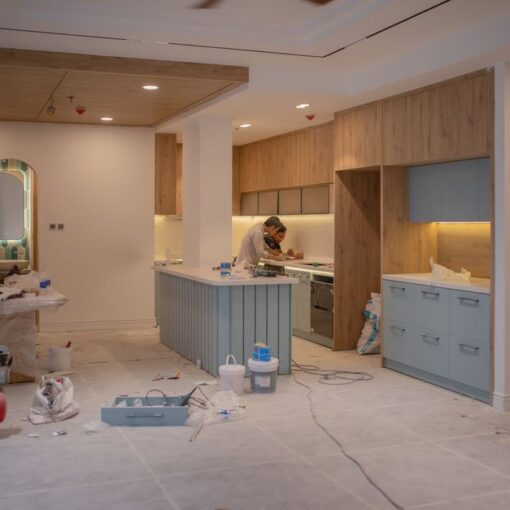
The final prep stage is protection. Countertops, floors, appliances, and adjacent walls are masked off with plastic sheeting and rosin paper. A dust barrier is set up to contain the work area. When you walk into your kitchen after prep is complete, it should look like a clean, organized worksite, not a construction zone.
Step 2: Priming and Spraying
With the surfaces cleaned, sanded, and masked, the first coat applied is a high-build, stain-blocking primer formulated specifically for cabinets. This is not the same primer you would use on drywall. Cabinet-grade primer is designed to bond to slick surfaces, block tannins and stains from bleeding through, and build a smooth base layer that can be sanded flat before the topcoat goes on.
The primer is sprayed, not brushed. This is non-negotiable for a factory finish. Professional refinishers use HVLP (high volume, low pressure) or airless spray systems that atomize the coating into a fine mist, laying down a perfectly even film with no brush marks. Some Lafayette specialists take this a step further by creating a mobile spray booth inside your home, using plastic walls and ventilation to approximate the dust-free environment of a factory finishing line.
After the primer cures and is lightly sanded, the color coats go on. These are not standard paints. They are catalyzed coatings, meaning they use a chemical hardener that cross-links the finish as it cures. Multiple thin coats are applied, with each coat given time to flash off before the next goes on. The result is a finish that is smooth to the touch, with a depth and uniformity that brushing or rolling can never achieve.
Step 3: Curing and Reassembly
There is an important distinction between dry time and cure time. A sprayed cabinet door may be dry to the touch within a few hours, but the chemical curing process takes much longer. Light use is generally safe after 24 to 72 hours, but full hardness can take up to seven days. A good refinisher will give you clear instructions about when you can hang the doors, when you can put items back in the cabinets, and when you can clean the surfaces.
Reassembly is methodical. Doors and drawer fronts go back on their original cabinets using the labeling system from day one. If you have chosen new hardware, this is the moment your kitchen transforms. The final step is a thorough inspection under good light. A true factory finish has no dust nibs, no runs, and no thin spots. It should feel like glass.
Choosing the Right Coating: Renner vs. Envirolak vs. Sherwin-Williams
The coating your painter uses is the single biggest determinant of how your cabinets will look and hold up over time. Standard wall paint, even high-quality wall paint, is not designed for the abuse that cabinets take. It will chip at the corners, peel where it meets the frame, and wear through on high-touch areas. Professional cabinet coatings are catalyzed, meaning they cure through a chemical reaction rather than simply drying through evaporation. This makes them dramatically harder and more durable.
Renner is an Italian brand that has earned a strong reputation among high-end cabinet refinishers. It sprays beautifully, lays down with almost no texture, and is available in a wide range of sheens from dead flat to high gloss. It is also low in VOCs, which matters when the work is happening inside your occupied home.
Envirolak is a water-based catalyzed lacquer that has become popular along the Front Range. It cures hard, resists yellowing, and can be tinted to match virtually any color. Many Lafayette specialists prefer it for its balance of workability and durability.
Sherwin-Williams Pro Industrial is a more widely available option that still delivers professional results when applied correctly. It may not achieve quite the same plastic-like smoothness as a true lacquer, but it is a solid choice for a durable satin or matte finish at a slightly lower price point.
When you are interviewing painters in Lafayette, ask them directly which coating they use and why. Their answer will tell you a lot about their experience level and whether they are truly cabinet specialists or general painters who occasionally take on cabinet jobs.
DIY vs. Professional: The Real Cost of a Mistake
The appeal of painting your own cabinets is obvious. The upfront cost looks lower, and there is a certain satisfaction in doing the work yourself. But the gap between DIY results and a professional factory finish is wide, and the hidden costs of doing it yourself add up fast.
The most common DIY pitfalls are easy to spot. Brush marks on the face frames. Drips along the bottom edges of doors. An orange peel texture from an improperly adjusted sprayer. Worse, many DIY jobs start peeling within months because the surface was not properly cleaned or sanded. At that point, the money and weekends you invested are gone, and a professional now has to strip everything back to bare wood and start over, which costs more than the original quote would have been.
The hidden costs of DIY are real. Renting a professional-grade sprayer runs over a hundred dollars per day. Premium cabinet coatings cost eighty dollars or more per gallon, and you will need several. Then there is sandpaper, tack cloths, masking materials, and the value of your own time. A full kitchen can easily consume two to four weekends of work, and you still may not be happy with the result.
There are situations where DIY makes sense. A single bathroom vanity, a small set of open shelves, or a piece of furniture are manageable projects where a less-than-perfect finish is acceptable. But for a full kitchen in your Lafayette home, the professional route is the safer investment. The cost difference, when you account for materials, tool rental, and the risk of failure, is smaller than it first appears.
What Lafayette Homeowners Are Asking (FAQ)
Can you paint factory finished cabinets?
Yes, absolutely. The key is proper preparation. The existing factory finish must be sanded with 100 to 150 grit paper to break the glossy seal and create a surface that primer can bond to. A specialist knows exactly how much to sand without cutting through to the wood substrate. When this step is done correctly, the new finish will adhere for decades.
How long does the process take?
For a standard kitchen, expect five to seven days from start to finish. This includes door removal, prep work, priming, spraying, curing, and reinstallation. Larger or more complex kitchens may take a few extra days. A reputable Lafayette painter will give you a clear timeline before the project begins.
Do you paint the inside of the cabinets?
We offer interior painting as an optional add-on. Most homeowners choose to have the visible interior surfaces painted, the back of the face frame and the cabinet sides, while leaving the shelves and cabinet floor unpainted for a cleaner, more practical look. We will walk you through the options during the estimate.
What cabinet colors are trending in 2026?
Soft neutrals continue to dominate. Warm whites, greige, and muted sage greens are popular choices that work well with the natural light and design sensibilities of Lafayette homes. Natural wood tones are also making a strong return. Navy, cherry wood, mustard yellow, and country red are considered dated. We can help you select a color that complements your countertops, flooring, and overall aesthetic.
Do you offer a warranty?
Yes. We stand behind our work with a workmanship warranty that covers peeling, cracking, and blistering. The specific term depends on the coating system used and the condition of your existing cabinets, and we will detail the warranty terms in your written estimate.
Why Lafayette Homeowners Trust Us for a Factory Finish
We have spent years refining our process specifically for the homes and conditions of Northern Colorado. Our service area includes Lafayette, Louisville, Superior, Erie, Longmont, and Boulder, and we understand the architectural styles and common cabinet materials found throughout the region. We are not general house painters who occasionally spray a set of doors. We are cabinet refinishing specialists, and catalyzed coatings are all we do. Every project begins with a detailed walkthrough and a written estimate that spells out exactly what will happen, how long it will take, and what it will cost. We treat your home with the care it deserves, using drop cloths, dust barriers, and thorough daily cleanup.
Get Your Free, No-Obligation Quote for Lafayette Cabinet Painting
If you are ready to transform your kitchen with a durable, beautiful factory finish, we are ready to help. Contact us today to schedule a free in-home estimate, or send us photos of your cabinets for a quick online quote. We serve Lafayette and all of Northern Colorado, and we would be honored to earn your trust. Your cabinets are the most visible feature in your kitchen. They deserve a finish that looks like new and lasts like new, without the cost and disruption of a full replacement.